

As I wrote last week, Men Are from Mars, Women Are from Venus gets truly an insane amount of hate for daring to talk about sex differences, especially given how egalitarian and conciliatory it is about them. Why does it get so much more attention than the dozens of “trad” and “red pilled” books that argue that women shouldn’t vote or hold jobs?
MMWV is provocative precisely because it’s not seeking to provoke. Most people find the edgelord books retarded and the convoluted bits of anthropology or neuroscience in them inaccessible. In contrast, “men should listen to women complain without offering suggestions” is the perfect scissor: everyone has an opinion on it from their own experience — just a slightly different opinion from everyone else’s. MMWV is controversial precisely because its subject matter is so mundane and familiar.
A criticism I haven’t seen levied against the book is: what about all the other sex differences? Men and women greatly differ everything from physical power to voting patterns to whether they know twhat “retrograde” means. MMWV elides these, but not because they have no implication on dating and relationships. Perhaps Gray wanted to focus on the one message he was sure of. Perhaps he was hoping to avoid controversy. LOL.
These other sex differences are uncomfortable to talk about both because of the subject matter and because the average discourse on the topic is so partisan and retrograde. Alex Kaschuta blames the same reactionary polarization that MMWV got belatedly dragged into. Feminism declared that all sex stereotypes are socially constructed and can be abolished at will, and so the anti-feminist position became that all sex stereotypes are immutable and true of every single individual. Alex concludes:
The tragic irony? The science of sex differences could have increased understanding between the sexes. Instead, it's become an information hazard - technically true at the population level but toxic when internalized as a guide to individual interactions. We've learned about averages but lost the ability to see individuals. In our quest to understand the opposite sex, we've made them more foreign than ever.
I agree with Alex’s assessment, but with a caveat: understanding the opposite sex means understanding precisely how they are foreign. Inter-sex resentment is born of seeing the other as a malfunctioning version of one’s own sex. It comes from missing the fundamental ways in which men and women are different, the things each of them sees that the other is blind to.
Is it a public service to try to open each gender’s eyes to what they’re missing, or an infohazard? Perhaps it is a hazard to the foolhardy, and a service to those with an open mind. To be safe, I’ll save that for subscribers only.

Violence
A sex difference people don’t like thinking about is that almost any man could kill almost any woman with his bare hands if they were completely alone. This fact is in a strange superposition of being both a huge deal and complete afterthought. (Also some people deny this because they watch female superheroes on TV or something? IDK, weird.)
If you’re a man, imagine if half of everyone you met carried a gun with them at all times. Would you feel safe? Well, it depends. I’ve been in this exact situation several times: on a Sunday morning bus in Israel when all the soldiers are heading to base, or at a diner in Oklahoma where everyone was open-carrying. I felt safe in these situations due to a list of mostly-unspoken norms that every armed person in these spaces abided by. Any violation of these norms, e.g. the carrier being intoxicated or the gun being worn in some unusual holster, would’ve immediately put everyone on edge even if there was no direct implication of violence.
That’s how it is with male physical violence, but with a twist: while women are the ones more vulnerable and aware of the threat, it’s men who must collectively enforce the norms that prevent it.
One example is being mindful of behaviors that might unintentionally signal threat, such as blocking an exit or aggressive communication. Some guys resent when this stuff is pointed to them, saying that of course they would never threaten women. The issue isn’t their own intention, but that this provides cover for the men who do move their body and raise their voice just so to threaten a woman into doing what they want. If other men don’t confront a man who does this, it raises the salience of potential violence. In any environment where that salience isn’t held close to 0, no friendly flirting is going to happen.
In these situations, women may wonder why men don’t take pride in acting the protector, and it’s often because the men are unaware of what’s happening. When men threaten violence towards other men they do is as overtly and ostentatiously as possible. You think you’re a tough guy, huh, come at me bro! When men threaten women, they do it covertly.
Sometimes a girl has to explicitly say “that guy is a creep, I’m not comfortable when he’s around” even though that’s risky and unpleasant. In turn, other men have to deal with said guy, even if they didn’t want to do so either.
Astrology
It’s not just astrology. Girls love to sort people into types: enneagram, attachment styles, Myers-Briggs, aura colors, Hogwarts houses, husband/hookup. In contrast, guys love to measure people on a scale: IQ, ELO, horsepower, net worth, bench press max, points per game, 10-point scale. Wherefore art Romeo and Juliet so different?

I believe this is a manifestation of two important psychological differences between the average man and the average woman. First: men are more interested in things, while women are more interested in people. Second: men think in hierarchies, women think in relationships.
Caveat: unlike upper body strength, there’s a lot more overlap in these psychological differences between men and women. This is especially true within a community: people with “male” or “female” interests will tend to cluster together, and so the differences between men and women within the group will be smaller.
Things can be measured, but people are too multidimensional for any limited set of measurements to be very informative. This is especially true for measuring people for the purpose of understanding their relationships. Men I know often get the idea to match people romantically by scoring them on the big 5 personality traits or something similar; it never works. The only purpose for which measurement is directly useful is placing People in a hierarchy.
In contrast, classification systems include a lot more signal at the cost of accepting more noise as well. That I am a 7w8 ESTP Taurus tells you much more about me than the fact I’m a 1200 chess player who benches 210: a lot more true things and some false ones.
“Woo” classification systems include epicycles that make them more flexible and less dogmatic, moon signs and wings and transitions. If I’m not as patient as a Taurus should be, an astrologer would easily explain this by Saturn being in Sagittarius in the year of my birth, fostering a yearning for freedom and exploration.
In a sense, astrology is like the knowledge of sex differences itself: it makes the stupid stupider by offering them a well-trodden path to Dunning-Krugerland. But for the wise, it offers a nuanced vocabulary to discuss people and their relationships.
I’m a man who writes about people and relationships. I won’t pretend to believe in astrology to sleep with an ignorant chick, but I’m very open to a wise woman teaching me to understand people better through the language of planets and stars.
Trump
There’s one more sex difference that makes everyone uncomfortable and pessimistic about dating, charted here by FT in a maximally confusing color scheme:
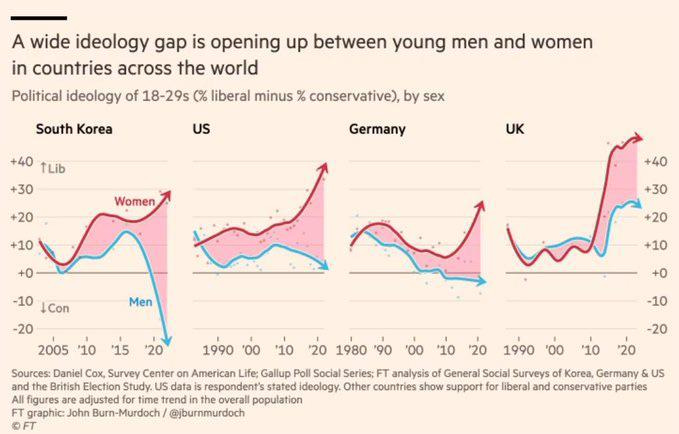
So, is dating doomed? Will girls drift ever leftward towards the 4B life while conservative men play their conservative video games, and never the twain shall hook up?
I don’t think so.
First: it’s not very clear what those charts are even measuring. The citation for the US data is this poll by the Survey Center on American Life which only asks two politics-related questions: Trump or Harris, and one’s identification on a 5-point scale between “liberal” and “conservative”. I couldn’t find easy data for 18-29-year-olds specifically, but unmarried women did favor Harris 23 percentage points more than unmarried men did. This is higher than the 19 point gap in 2020, but lower than the 28 point gap in 2016 — the last time Donald Trump ran against a woman. Women slightly prefer Democrats and women candidates, but this preference doesn’t seem to be exploding in recent years as the arrows on the chart would suggest.
More importantly, Trump vs. Harris isn’t an ideology. Not that many in the 18-29 demographic have one.
Single people declare that they wouldn’t date anyone with different politics in part as virtue signaling, and in part because they take political leaning as one of the few available proxies for “good person” you could apply to a stranger. Politics is certainly used more as a proxy for character than in previous decades, but that’s not necessarily a bad thing. The percent of people who declare they wouldn’t date someone of a different ethnicity or religion is going down in parallel to politics becoming a bigger dealbreaker, and politics is a lot more malleable than these other proxies.

When two people actually start dating, they have a lot more information about each other’s character than who they happened to vote for. They mostly end up moderating each other’s views, not breaking up over tariff policy. Or sometimes they don’t — that’s ok as well.

"MMWV is precisely because its subject matter is so mundane and familiar."
Missing word?