

Trophies
A persistent topic of “the discourse” is whether rich, successful men want to marry the overeducated girlboss or the simple tradwife. Most contributions to this discourse consist of the airing of class grievances, but sometimes somebody bothers to collect some actual data. Turns out, rich men want to marry the overeducated tradwife.
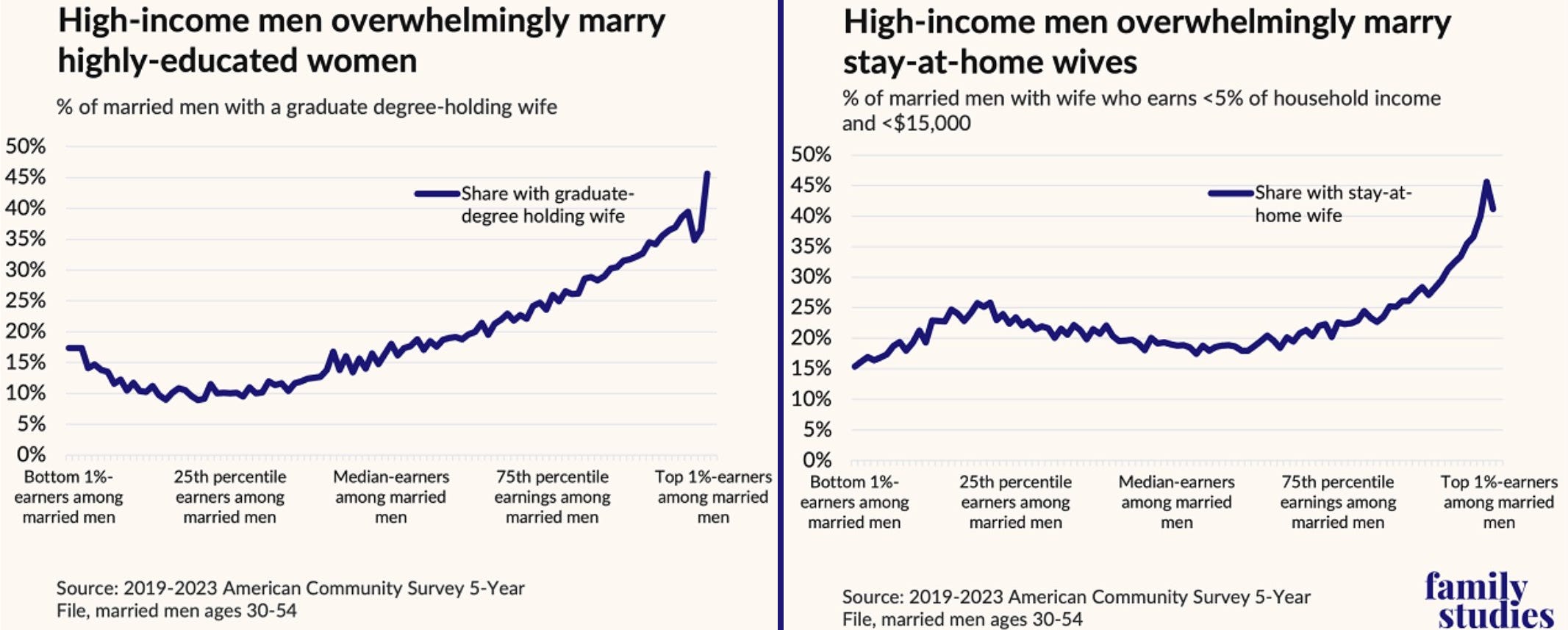
One spin on this is that men want a trophy wife to show off to their friends. In 2025, trophiness is measured in advanced degrees and venture funding, not just in waist-to-hip. This belief is mostly held by two subsets of educated women: those who never liked men and don’t expect to marry them, and those who feel that being a trophy wife sounds lovely and chill, actually.
Successful people in actual marriages, like Simon Sarris, think of it a bit differently:
I somewhat dislike this common line, “want to take these women out of the workforce". My wife and I run a small firm together (our family). There are many things to get done, lots of delegation. One of the tasks is "go get money" so I also have a job […] "on the side". That's what 99.9% of jobs are. It's fundraising for the bigger thing, which is my family and my life.
Men want educated, talented, and agentic wives for the exact same reason they want educated, talented, and agentic business cofounders. The real prize isn’t the credentials your wife accumulated in the few years before you married, but what you’ll build together in the decades after.
Entertainment
A couple of years ago, I wrote about couples that build together vs. couples that entertain each other. Most people got the premise intuitively, and 60% of those in relationships chose the building path.
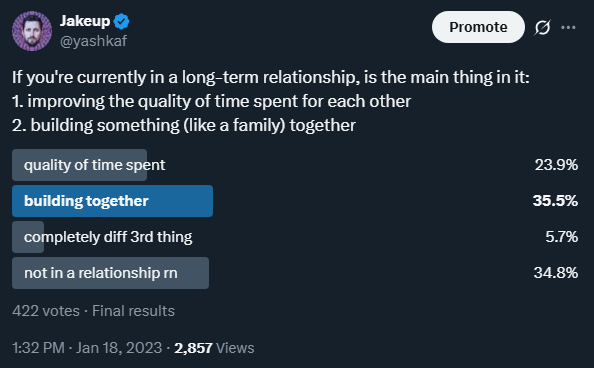
Even though most people want to build together, almost everyone inadvertently selects for entertainment only:
A woman wants a husband to have 3 kids with in a house with a picket fence. So she goes to the bar with 10 strangers off an app and picks the one who’s most charming after three drinks…
This extends to “data-driven” matchmaking. OkCupid tried to assess a compatibility score but mostly ended up measuring lifestyle similarity since the majority of questions were about hobbies and culture war signaling. My friends in NYC ran a matchmaking project based on a survey of 400 questions that correlated for friends and roommates.
But roommates aren’t building anything. Some people discover this by trying to date their roommates. I went in the unexpected direction: after Natasha and I broke up over our incompatibility as partners, we lived together for over a year in a small apartment. We could never raise a family together, but we were perfectly capable of providing each other with pleasant company.
Good roommates are predicted by similarities: shared politics and religion, homebody vs. party-animal lifestyle, similar circadian rhythms and music tastes and tolerance for mess in the kitchen. But no one picks a startup cofounder who’s identical to them. You want to be aligned on the vision, but have complementary skills that cover everything a business needs to thrive. It’s the same for the family firm.

Alignment
People have a decent idea of the things a couple should agree on before tying the knot: children, geography, monogamy, frugality, sex, in-laws, house plants. Above these specifics, there’s a governance layer that’s often left unspoken: How flexible or rigid are you going to be about all these topics? How conservative or ambitious? How will you prioritize them against each other? Is marriage a sacred duty, or a pragmatic strategy?
Are you here for self-fulfillment, or to build?
My post on the two types of couples was inspired by a friend couple. While my wife and I were clearly building, their marriage was oriented towards and sustained by entertainment and quality time. A short while after I published my post, they divorced.
My sense was that one of them was looking more and more to start building together, buy a house and have a kid. Their spouse agreed that it would be good “some day”, but it was never a priority. You can’t run a company where one cofounder is designing a lifestyle business, and the other is gunning for a unicorn.
Complementarities
The couple as a firm faces an important constraint: it will never have more than two full-time employees no matter how many roles need filling. A marriage succeeds when every role can be covered by at least one of the partners, and when that person has the other’s trust to own it. Every couple builds something different, but here’s a short list of essential roles:
Chief Revenue Officer
People often look at how much their partner is making when they start dating, but long-term income stability is more important. Some careers are high-variance, like entrepreneurship or playing “tenure or bust” in academia. Some people are employable across different fields, geographies, market conditions, and AI timelines. Even if both earn an income, the CRO is the one whose income the couple depends on.
Director of Ops
The job of tracking and assigning chores is at least as hard as the chores themselves. This role often falls on the person who is less tolerant of mess and expired milk, not the one who’s better at it. Then their partner resents being bossed around instead of being grateful that the burden of chore management is taken care of. It’s much better to make this an explicit appointment.
Social Dev
A couple needs a friend group and a broad circle of acquaintances who are at a similar life stage (e.g., other couples with young kids for playdates). This is different from the simple union of each person’s individual friends. There’s usually one person in the couple who’s better at making friends, who’s more extroverted, connected, etc. That person needs to remember that they’re making friends for the couple, not just for themselves — don’t complain about your spouse to shared friends!
Equilibrium Manager
“Codependency” is often just two unstable neurotics marrying. You need one person in the couple who can cool their own anger and dispel their own depression. Even if they can’t help their partner right away, they can keep things from spiraling out. Of course, you’d want both partners to be able to do this, but it’s inevitably going to be easier for one of them, most of the time. That person shouldn’t get resentful about it — quelling resentment is the EM’s chief KPI!
VP of Vibes
The one who makes the joke in a tense moment, plans date night, offers a back rub when morale is low, picks the right playlist, turns a sleepy mood sexy.
General Specialist
Like any growth company, a young couple needs to be agile, with both people ready to step up into new roles or face unexpected challenges. Even for those, it’s good for a couple to figure out how their broad skills complement each other.
Example: I’m rarely undecisive; my wife, Terese, is rarely underprepared. I take on the many tasks that require swift action, like catching a cockroach or settling a bill dispute. If the problem requires diligent research and preparation, like the elimination of plastics from our diet, it inevitably ends up in Terese’s domain.
The benefits of specialization and delegation accrue to more specific tasks as well. Terese and I host brunch every other week, which usually involves me inviting people, her setting up the space, me buying groceries, her cooking the meal, me washing dishes, her watching the kids while I do it, me leading the chat from the center of the circle, her taking care of anyone who’s left out.
The end result is a better Saturday than either of us could have by ourselves. Common dating advice says that an extrovert who likes loud conversation shouldn’t marry an introvert who likes intimate meals. But our brunches allow each of us to have the experience we want, enabled by all the things the other does.
Work
There’s one other thing that building anything worthwhile requires of both people: work.
Some people have little ambition beyond indefinitely maintaining the lifestyle of a young bachelor. Even so, being in a couple takes work: the work of keeping your partner happy enough to stay with nothing durable that binds you together. If you want to upgrade your lifestyle, make new friends and have a nice house for them to visit, and keep up with the Joneses on DINK Instagram, the labor requirement grows.
Of course, any grand project such as raising kids together requires a commitment to doing work. If you’re hiring nannies, cooks, and cleaners, these need to be vetted, managed, and afforded.
For most people, work by itself is neither good nor bad. I personally dislike work that feels pointless or tightly circumscribed, which is why I left that one silly hedge fund and also Nasdaq. I like work that’s meaningful and allows me to express myself, which is why I’m writing this Substack, raising two kids, and applying for early-stage startups.
When I met Terese, she was working long days for something she personally chose, which I took as an extremely positive sign. I was correct.
I notice a lot of women who complain that they can’t find a husband simultaneously signal how much they hate work. They complain about their jobs, about being asked favors, about “emotional” and “social” labor. They brag about putting no effort into dates. They post that kids are “too much work”, and that they’d rather be the fun auntie. They write on their app profiles that it’s unfair to demand adulting of someone born to be a spoiled princess.
You can find a successful guy to marry whether you’re tall or skinny, chaste or slutty, high school dropout or doctor of olfactory ethics. And plenty of successful guys will put up with a hot indolent chick for some short term fun. But successful people work hard and are surrounded by other hardworking people; who in their right mind would marry someone who isn’t?
Last week, I wrote about the challenge of capturing a man’s full attention and the benefits to both of a woman rising to this challenge. Seducing someone requires effort and skill, and no one can do this to themselves. There is no better way to convince someone to found a relationship with you than show you can do what they can’t and that you’re willing to put the work in.
There's a NY Times article today introducing "mankeeping":
> It describes the work women do to meet the social and emotional needs of the men in their lives, from supporting their partners through daily challenges and inner turmoil, to encouraging them to meet up with their friends.
If you were worried that the signs of an indolent spouse are hard to spot in advance, the Times gives us a convenient one-word disqualifier. TYFYS, NYT!