

On my 23rd birthday, I took the last Friday bus out of the Israeli desert for a two-hour ride back to my hometown. I spent 11 hours each day of that week working a low-paying job I wasn’t good at with people who didn’t respect me. I lived in a small apartment with four cats and two roommates, one of whom1 ate my birthday cake without permission. I hadn’t gotten laid in two years. I hadn’t been in a serious relationship in four.

This was the starting point for my journey up the “marriageability curve” I introduced last week. It’s the path from being a nobody (as far as the marriage market is concerned) to becoming a husband. Here’s my path.
Positive Momentum
The first part of the curve is painfully slow. It’s hard to get better at dating if no one wants to date you, and girls won’t date someone who gets no girls. But you can still be making exponential progress in the mathematical sense: compounding improvement relative to where you were last year, even if there’s little absolute improvement in your dating outcomes.
To build on steady progress, the crucial thing is to steer clear of the undertow that drags you backwards. Dejection, resentment, learned helplessness, rumination, victimhood, dating discourse. If you avoid the traps and live your own life, it will teach you the wisdom you need.
The inflection point in your journey comes when you don’t expect, usually after years of barely perceptible progress. For me, this was my 23rd birthday.

At 23, I wasn’t feeling particularly bad about my life. I was still close with friends from high school, and we were mostly going through the same flailing of young adulthood. I was finally out of the military and living on my own, which meant that I was finally free to dress how I wanted and play as much Civilization IV as I wanted. I dressed poorly, but Civ kept me from going online and falling prey to egregores. I still liked girls a lot, even if they didn’t respond to my overly sincere messages on crappy dating apps.
I was learning how to be an adult — taking care of my basic needs, showing up professionally, socializing with people I wouldn’t naturally be friends with. I signed up for the GMAT on a whim and studied every day during dead hours at work. While much of my day-to-day was a bummer, my overarching life mood was one of indefinite optimism.
Two months after my 23rd birthday, I took the GMAT and scored in the 99.5th percentile. My optimism suddenly became a lot more definite. My job became a placeholder as I worked on business school applications. My material conditions stopped being a reflection of my worth, just a temporary circumstance.
In July, I got an email from a Russian acquaintance I met on Birthright during my service. She was in Israel with a friend named Natasha, did I want to meet up? The answer was no, it’s 100 degrees outside and the World Cup is on. But I owed her for entertaining me in Moscow when I visited. I turned the football off, texted a few friends to meet us at the beach, and got on the bus.
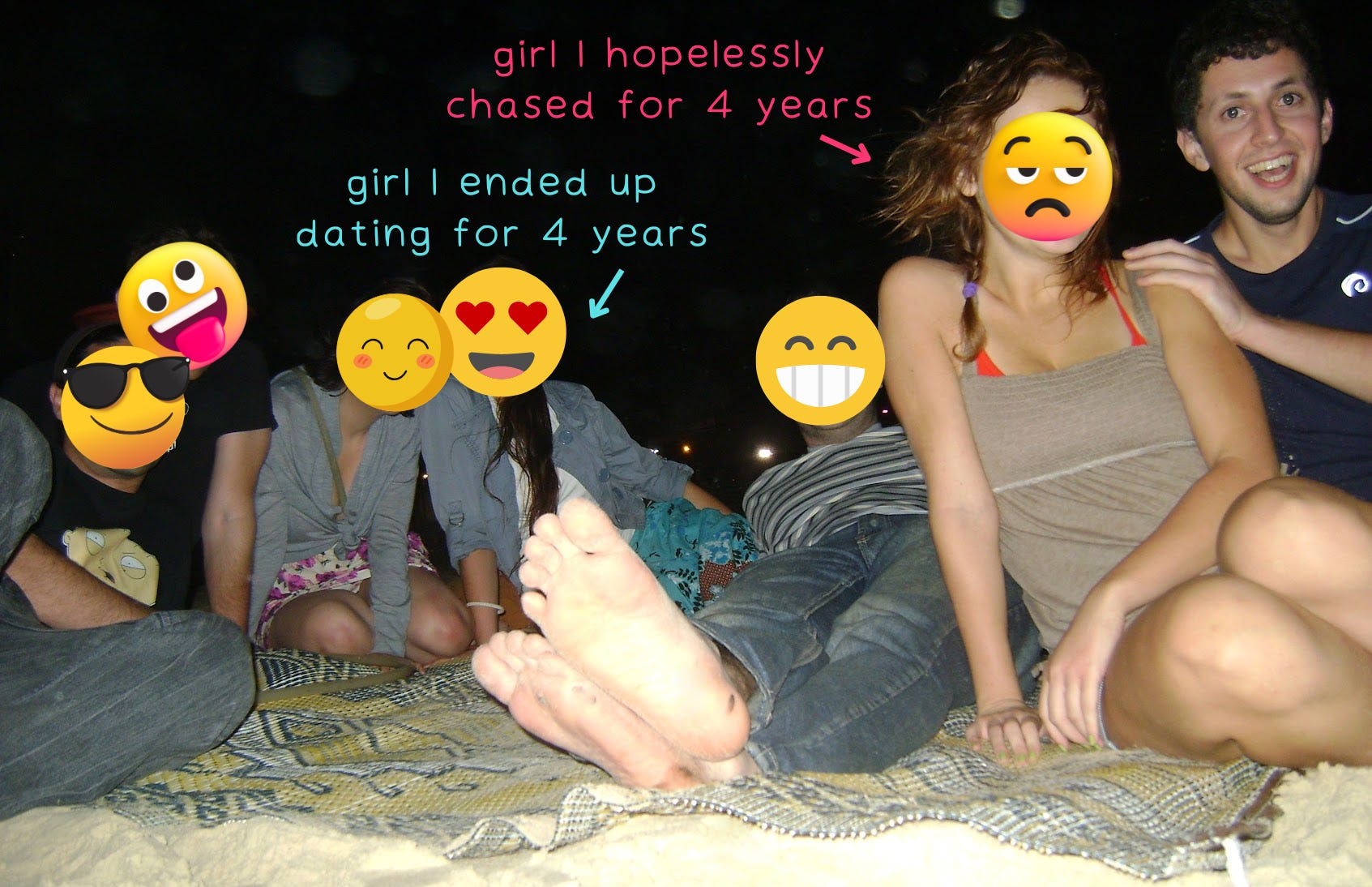
This photo was taken that night. I’m in the corner, my hand resting awkwardly on the shoulder of a classmate I’ve been fruitlessly pursuing for years. Natasha is in the back, ignored.
But over the next week, she and I got a few occasions to hang out. We talked about Siberia, mathematics, and the desire to escape and start fresh. I wasn’t trying to flirt or even impress her, since Natasha lived 1600 miles away in a country I was never going back to. The evening before her flight, I invited her to sleep over at my parents’ place. We ended up talking all night. At 5 am, I drove her to the airport, got out of the car, and finally realized that we’re both hopelessly infatuated. We kissed and she flew off.
Stumbling on Abundance
With a 60:40 female-skewed gender ratio, the University of North Carolina in Chapel Hill is a great place to meet girls. Unless, of course, you’re a broke immigrant weirdo nerd who’s a bit too old to date undergrads but younger than every girl in b-school. Which was fine by me — I wasn’t going to cheat on Natasha, who still lived in Moscow, and I was busy enough trying to meet friends and/or employers. To make things simple, I just assumed that girls weren’t interested in me.
And then, in my second year, they suddenly were. Girls started smiling at me more, inviting me to parties, dancing closer. I started getting compliments: on the math workshop I ran, my comedy skits, my brown eyes. Here’s how The Economist reported on what happened next:
Jacob was standing in the stairwell outside an apartment, half naked and holding his clothes, when he first considered dating two people at once. A few minutes before that he’d been in the flat of a classmate on his MBA programme at the University of North Carolina. She had invited him over to work on a project, then walked out of her bedroom in her underwear. Jacob was startled. His first impulse was to undress, too. Then he remembered that, in a more sober frame of mind, he’d weighed the pros and cons of cheating and decided against it. Grabbing his clothes in a panic, Jacob fled. […]
The next time he and Natasha met up, Jacob popped the question: what about an open relationship?
I’m sometimes asked if I’ve “always been polyamorous”. It’s a bit hard to answer. For the first 25 years of my life, I had no idea that ethical nonmonogamy existed. But when I realized women could possible be pursuing me I had a spontaneous nonmonogamy epiphany not 5 minutes later. I felt no possessiveness about Natasha, just a desire for her to enjoy the same abundance.
What changed over these 2-3 years that made women suddenly interested? I certainly got older, more mature, less arrogant. I got more competent at everything from cooking to dressing to financial modeling. But the biggest difference was that I stopped trying to impress women deliberately and just was friendly and open with everyone I met. I flirted with Natasha without trying to because I didn’t think we could date, and with the UNC girls — because I had Natasha.
This is part of why I’m so reluctant to give itemized advice on where to meet women and how to flirt. I met women by making friends: being sociable, going out even when I felt lazy, and keeping in touch with acquaintances. It took until I was in my 30s and married for my purposeful “flirting game” to work better, on average, than sheer obliviousness. The only “trick” I really learned was just to listen and pay more careful attention to the girl I’m with.
A friend of mine was devoutly Christian until he was 25. He wasn’t looking to get married young, and since premarital sex was off the table, he wasn’t looking to get laid either. A month after he left the faith, he had his first hookup followed soon after by the second and the twentieth. We chatted about how the years of self-imposed celibacy probably helped him find success later. Instead of building resentment through years of frustration, my friend spent his early twenties making friends and leveling up as a man. Once he embarked on the path of porking, his earnest naiveté wasn’t a detriment.
I usually advise people not to put off dating for too long. Romance is a complicated game, and you only learn by playing. But you don’t necessarily learn the best lessons by playing on ultra-hard difficulty. If your dating life seems to teach you only painful lessons, you could take a break and practice the relevant skills in lower-stakes situations.
Committed
Just before I turned 26, Natasha announced that she had an opportunity to relocate to New York City. This led to me taking a job offer at a niche little company named Axiom SL, by far the best career decision of my life. It also led to me contemplating for the first time if I was ready to get married. After three years dating across oceans, we were going to move in together, and the clock would start ticking on the big decision. I decided that if living together went well for a year, I was going to propose.
Unfortunately, it didn’t. Natasha struggled to settle in a new country and felt that I wasn’t attentive or supportive enough (I wasn’t). I was frustrated by her mood swings, arbitrary obstinacy, and the suspicion that she kept secrets from me (she did). Half a year after we moved in together, Natasha and I broke up.
I made an OkCupid profile2.
When I moved to NYC, I made the decision for myself that I was ready to be a husband and start a family. I still felt like that when I went on the app. and I knew somehow that women could tell that I was serious even though my profile photo very much wasn’t:
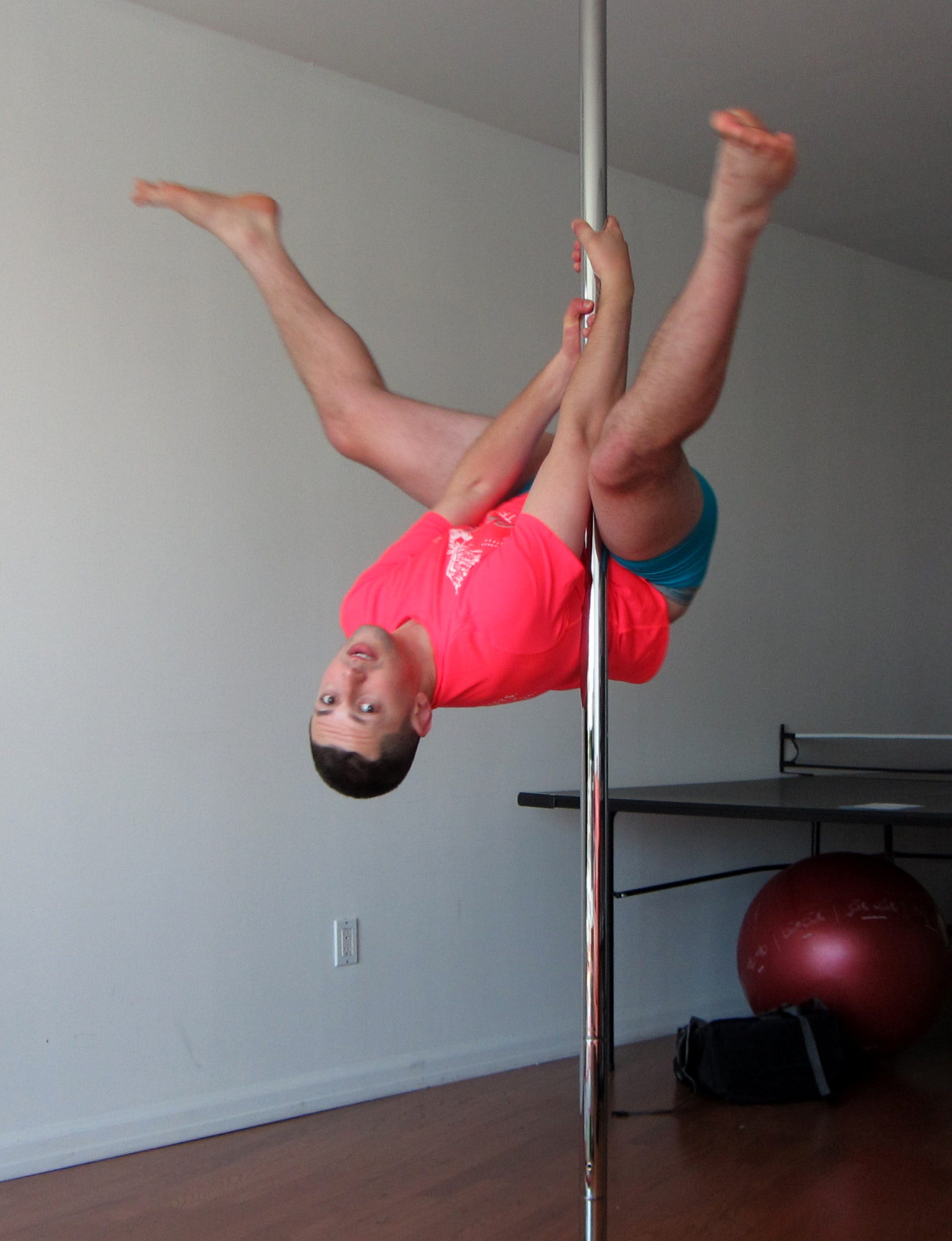
My desire for a serious relationships and my sense of abundant optionality both led me to make my profile as distinctive as possible. I didn’t care how many women I turned off by my weird humor or refusal to engage on culture war topics. I knew there would be more matches, even if I had to wait. I waited for one that I didn’t have to hide any part of myself from.
On the eve of my 28th birthday, Ella met to break up with me in person. She was a journalist with hypnotic curves and a sharp wit. We had been dating for two months. At our last meeting, she told me that I was simply too much of a nerd. You keep talking about all of this economics and gaming theory and probabilities — who cares about this stuff? Women don’t care about this stuff. When she got up and left, I had much to think about.
I had already doubled down on a few things that women warned me against, and to good effect. But I worried that I was hitting the limits of this approach. Ella was intelligent, a great match for me in many ways, and surely knew more than me what women like talking about. I enjoyed the weekly Rationalist meetup where we chatted about economics, game theory, and Bayesian epistemology, but I also noticed that fewer than 15% of the meetup’s attendees were of the female persuasion.
I decided to risk doubling down one last time. I added two lines to the “six things I could never do without” prompt on my profile :
7. The freedom to break arbitrary rules regarding the number of items I must list
8. Bayesian epistemology
I figured that it’s such an obscure term it wouldn’t even register for most women reading my profile. And if there was at least one woman in the whole city who wanted to talk with me about it, I really wanted to talk to her.
A month later, I did:

In the years since, Terese and I often talked about how lucky we were to have met in that particular brief window of our lives. A few years prior, neither of us was ready for a serious relationship. In the absence of aligned life plans, we would have gotten stuck on superficial differences and immaturity. A few years later, and it’s likely both of us would have been married to someone else. We both came to NYC the summer before we met. We had a year to establish ourselves as independent adults and to sample the abundance of casual dating in NYC. We had both just recently become seriously marriageable, and recently decided to be serious about marriage.
This is my story; yours will be different. But this sort of growth curve didn’t just happen to work for me by lucky accident. It’s a sequence where every step builds on the previous one and requires it: slow progress, then inflection, then abundance, then desire to commit, then building a marriage.
I didn’t realize the importance of this sequence when I was going through it, but only after meeting so many guys who stumbled off it. Some fall into frustration during the slow early ramp up and look for shortcuts. Some seek to commit while in denial about their yearning to experience abundance. Some guys with abundance lie to women and to themselves about their desire to commit.
If you’re stuck and not sure what your own story could look like, maybe this will inspire you to write a similar one. The girls are waiting for you to get there.
Probably a roommate, not a cat.
Unfortunately, in 2025 dating apps are dead.
Just added Bayesian epistemology to my Hinge profile! wish me luck