

I don’t watch the news, but I skim the sports section and “for you” tab on Twitter, so I feel I’m mostly abreast of events. This last week certainly flooded us with events up to our nipples. From what I can gather:
Following their playoff loss, the Washington Congressionals appointed a new secretary of defense, offensive coordinator, and special forces coach. All three turned out to be white nationalists on H-1B visas.
Elon Musk used stolen Chinese AI to deport all gang-affiliated USAID workers back to Massachusetts.
Kanye West and the Doo Wop Haters won “best girlfriend” at the Grammys.
Facing tariff pressure, the Dallas Mavericks traded Luka Doncic and the Gaza Strip to Denmark in exchange for Greenland, 20 Dogecoin, and Justin Trudeau’s expiring contract.
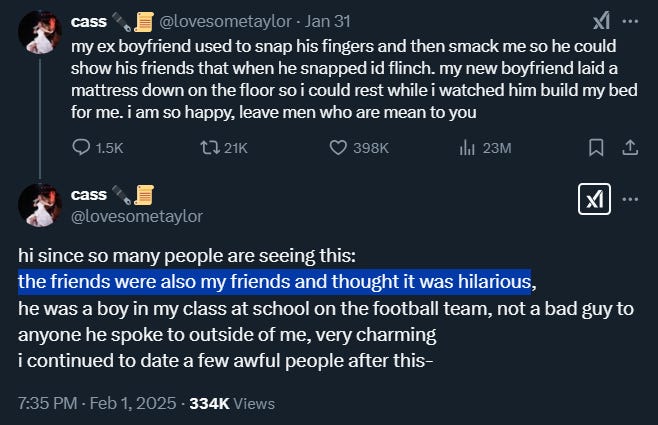
This was the most discussed tweet on my timeline this week:

Is she bragging or confessing? A brave victim or cunning manipulator? Is she grateful for IKEA boy or secretly fantasizing about Pavlov? And what’s the deal with the floor mattress anyway, did a dog type this?
More people chose to opine on a low-context dating-adjacent tweet from a person they’ll never meet than about anything else that happened this week. The same is true most weeks. For a supposedly private pursuit, people do love telling the public about their dating lives and the public loves to get its nose all up in it.
Why is everyone involved playing this game of confessions, gossip, moralizing, advice, signaling, and countersignaling? And is this actually helping anyone date?

Seductive and Anti-Inductive
The reason everyone has an opinion on everyone else’s dating life is, paradoxically, that no one has any idea what they’re doing and what’s going on.
Dating is kinda like poker. You gotta risk something to get something, but you have to be wary of busting out. You have your starting hand (e.g., your looks), you have your luck, but the best players know that it’s skill that comes through in the end. It’s important to read the cards, but more important to read the players: what are they hoping for? What do they think you have?
You could luck into a perfect hand early. You could squander most of your chips chasing bad situations. After playing for a while, you try to cash out a relationship, and that it matches what your luck and skill deserved.
Or maybe, dating was like that. People dated in communities where everyone agreed what the rules of the game were and what each hand was worth. Perhaps in one place guys always brought flowers and girls pretended to be deflowerable. In the next town over, bachelors go into debt to acquire a degree in tulipmancy. It didn’t matter what people did elsewhere — you could just look at what the local community nudged young people to do, and if you complied then a suitable match would be nudged your way.
I’m not actually sure this was true for most people in the past, I wasn’t there. What I’m sure of is that in the present, people feel that this has been lost. Today it’s hard to know what the chips are worth, let alone what the winning hand is.
The obsessive discourse around dating is people trying to figure out the rules while simultaneously trying to bluff themselves into a stronger position.
Here’s a sampling of things women said give them the ick about men that got at least a thousand quote tweets:
Catches a cold
Texts too promptly
Calls her “wife material”
Texts too infrequently
Calls her “hot”
Ducks when he hears shots
For the woman, these tweets serve a signaling function: “I’m so desirable I can impose arbitrary standards on men and not vice versa. If you don’t agree it’s because you’re ugly and should feel insecure.” It’s a bid for standing among other women. It’s fine if someone replies, “what’s wrong with ‘wife material’?”, that’s just banter. But if someone replies, “I catch stray bullets square in the chest but your hairstyle gives me the ick” then it’s war.
Everyone else piles into the discussion to negotiate the relative value of various traits in the dating game. Is Japanophilia a bigger turn-off than double-texting? How many extra inches would offset a guy sneezing? And how about women who “get the ick” so easily, do they know their worth or are they childish and insecure?
A guy finds out that the cute girl he just moved in with used to date Thanos. Should he be extra affectionate to help her recover from abuse? Try BDSM to indulge her kink? Ask her about it? Hit the bricks? Does she appreciate him more for the contrast, or will she dump him if her ex comes calling?

This wasn’t covered in high school sex ed or the 10 minute “talk” he got from his dad. He probably has no one he could ask and get a thoughtful answer without jeopardizing his own status and his girlfriend’s reputation. So: he and 18,000 other guys bookmark Cass’ tweet and try to figure out from the madness what the hell the dating meta is in 2025.
Date Local
There are a few downsides to trying to figure out the rules of dating from an open discourse with 23 million strangers who themselves are signaling, bragging, negotiating, or simply lying. It’s not just that everyone has ulterior motives that don’t include helping others figure out the rules, they also have no clue themselves. The discourse selects for memes that make dating seem excruciating, and it selects for the most excruciated people to contribute to it. The more confidently someone asserts a take about a stranger’s entire personality and dating life from a single out-of-context tweet, the less you should trust that take.
This is because dating markets are particular, not universal. No one dates in their entire city or country, let alone the entire internet. Local dating markets value what is locally scarce and discount what’s ubiquitous. And every dating market has its own norms in part because norms are themselves an axis that dating markets fragment on, along with things like geography, age, class, and relationship goals.
When I started dating in NYC, I faced the fateful conundrum: when to text after the first date. Game theory suggested that I should text the next afternoon to prevent uncertainty from disrupting the positive equilibrium of the stag hunt game; my nerdy friends agreed with this analysis. My work colleagues said that it makes me seem too desperate to settle down, a real “player” would signal he has other hotties lined up by remembering to text only a week after the fact.
Terese seemed nerdy enough on our first date, so I texted her promptly at 5 pm the next day. She asked her own colleagues what this implied, and they unanimously agreed that it proves I’m only looking for sex and nothing serious. Thankfully, she thought “still worth it!”
Three virtually indistinguishable groups of mid-twenties New Yorkers, three entirely different norms on such a basic thing as text timing. And what about norms regarding who pays for the date? When is exclusivity presumed? Is it ok to complain about your partner to friends? Is it funny that your girlfriend flinches when you snap?
The global dating discourse won’t produce the clarity everyone is desperate for because dating values are local. When a million strangers from a thousand dating subcultures try to hash it out on the everything app they create mostly noise, not signal.
Speaking of signals: listening to what people in your dating market say is worth more than surveying the whole internet, but observing what the locals do is worth even more than that. What stands out about the sorts of people the attractive locals are pursuing? How do people in happy relationships around you treat each other, and what don’t you ever see them do? How do people flirt?
There’s another important lesson, one we’ll revisit later. If you don’t like the neighborhood, you can move. The endless disagreement about what’s attractive, what’s cringe, and how to date means that you can probably find some community where what you got is sought after and how you roll is respected.
I’ve read dozens of interpretations of Cass’ tweet, some optimistic and some blackpilled, but I haven’t seen anyone spell out the true whitepill scenario. Here it is:
Cass successfully moved from a dating community where physical abuse is trivialized to one where guys are nice to her. This is what she actually wants, she’s fine.
Cass’ new boyfriend is part of the latter community, and the longer Cass spends there the more social reinforcement she will get that his acts of service are to be admired, not scorned. Over time Cass will think about her ex less as she absorbs the new norms and loves her new bf more.
Cass’ ex is clearly part of a community where his particular kink for physical dominance is respected, and masochistic girls who enjoy getting smacked will eventually filter their way there. With Cass gone, he’s free to look for a better match for him.
Is this true of these three characters? No one knows, likely not even Cass herself.
But it could be true for you.