

Education-skeptics often say that schools don’t teach kids anything. That’s false.
Schools teach kids that their personal worth is measured by impersonal artifacts: an assignment, a project, a test. It doesn’t matter who produced the assignment, whether they enjoyed or suffered through it, or what it meant to them — if anything. Schools call this “fairness”.
The assignment is graded by some authority. It doesn’t have to know who you are. The grader doesn’t enjoy the grading, and certainly finds little meaning in reading what the student produced. Schools teach that deciphering the grader is more important than understanding the assignment. Each teacher is a code book to be cracked; each test, a system to be hacked. Schools call this “supervision”.
Schools teach that outcomes are improved in monotonous fashion by the application of effort in any available direction. Some students do better by cranking through more test problems, while others benefit more from watching a video or doing extra credit tasks. But in all cases, doing more of any of these things improves your grades. Exploration may or may not be rewarded, but exploitation is always encouraged. Schools call this “studying”.
School assignments aren’t real. They don’t create value in the world or directly improve the individual. They are arbitrarily chosen under the weak constraints of vaguely subject-relevant and easily gradeable. Schools call this “education”.
The one thing that’s not school
By the time a young person takes their first job out of college, they have spent almost their entire life doing school assignments. School itself, obviously. School admissions as well: the more holistic they claim to be, the more annoying the assignment they require in the form of tailored essays or curated CVs. Job applications. Social media too, with daily assignments such as “repost current snowclone format” or “express appropriate outrage at current thing”.
The first, often only thing in a young person’s life that isn’t a school assignment is dating. Looking for love is deeply personal and inextricably subjective. Seduction is unfair and unsupervised. There is no gradient that can be monotonously exploited for more relationship success.
Naturally, educated young people hate this and rail against it.
They complain about dating more than they date. They read dating advice to “learn the rules”. They look to the discourse to grade them, expecting universal, impersonal answers to every conundrum. They write date-me docs that are so similar to their friends’ you’d swear they cribbed the notes. They try to cheat on the assignment by asking an LLM (or their favorite dating blogger) to write their profiles for them. They double down on what they’ve been doing, whether mass-swiping or soulmate daydreaming or DMing e-girls with BPD, regardless of how it’s been working out so far.
When young people get into relationships, it often doesn’t feel real. The couple has no life, meaning, or social role of its own. It’s not in the service of building anything, and in any case the people in the relationship selected each other for mutual entertainment value. They often ask of their romantic involvements what does this say about me? because they don’t know how to ask, is this what I desire?
Want not waste not
The first and most impactful thing school teaches students is to not have desires.
Kids in first grade are asked what they want to be when they grow up. Astronaut! Scientist! Memecoin shill! Circus stripper! And then — surprise! — no one gives a fuck. Turns out that the paths to outer space and the circus both require five paragraphs on post-colonial themes in Macbeth, due Tuesday. And you better not be caught doing any unsanctioned space acrobatics in school itself, that stuff will go on your permanent record.
In a spirit of noble sacrifice, I once joked on Twitter that we lock up guys at their horniest with girls at their sexiest and expect them to learn calculus. If you’re not unusually intelligent then A, the algo has learned to show you tweets so blatant you forgot what irony is and B, you definitely didn’t take calculus in college. The strongest drug hit on social media is “catching someone” being low-status outgroup. Especially if you get to do it in a mob of a thousand identical QTs, which my tweet swiftly accumulated. I wonder where people were taught this particular behavior pattern, hmm.
Jokes aside for a moment — why do schools expect anyone in that environment to learn calculus, or at least calculus-adjacent exam solving? Are students driven by a primal desire to chain rule derivatives? Or did the longhouse successfully cure them of any desires aside from mimetic competition for markers of success, so that an A in Calc is more motivating than boiling pheromones?
The statistics are clear: kids these days are drinking less, smoking less, going outside less, and fucking less. But their grades are higher than ever! Do kids get better each year at gaming the system, or is the school system getting better at gaming them? It’s the same game either way.
Other people’s fantasies
When people think school + love they imagine the QB kissing the cheerleader because that’s what Hollywood scriptwriters told them to imagine. The truth is that it’s almost impossible to love the cheerleader or the quarterback. He’s the Schelling point of desire, he’s what you think everyone else wants. It’s not love — it’s mimetics.
Young love is two freak nerds making out backstage of the school play rehearsal, their reflection in each other’s four-eyes making them forget for a brief while how everyone else at school looks at them. If you saw true love at school, you were taught to point and say eww, gross.
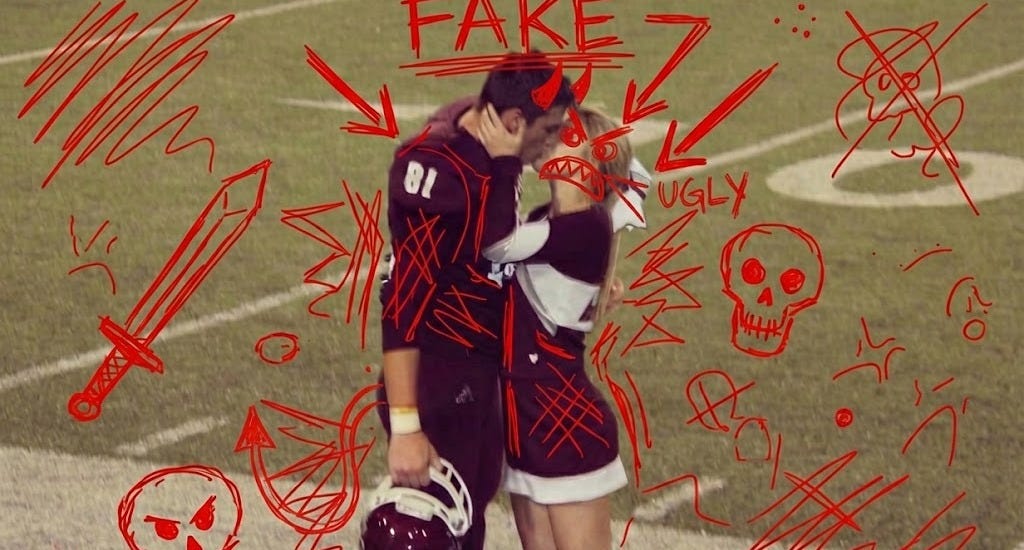
Love means feeling a desire fulfilled that’s entirely your own, and fulfilling a desire that only you can. Second Person has talked a lot about the cultivation of your own unique value proposition, and a bit about the cultivation of personal desire. The latter isn’t something a blogger can really help you with.
One of the major obstacles to the development of personal desire is the abundance of other people’s fantasies that can be indulged in risk-free. If only I was picked to throw deep balls, I’d have mine deep in a cheerleader!
Other people’s fantasies are, sadly, porn:
So rather than fantasies that risk failure but at least clarify our real desires, we find it easier to want things that we are told to want — that we don’t want, but that there can be no guilt in wanting because they were commanded to be wanted. Since it’s too painful to fantasize what will never come to pass — or shouldn’t come to pass — we drown ourselves in other people’s visions and are led mechanically to the end, see also politics, economics, love.
Readers wanted Second Person to be dating school, to explain to them how dating works and what assignments to complete to get the grade gf you see other people get. I tried to avoid writing self-help porn — essays that leave you not motivated upon having read them, but satisfied.
And so this essay will conclude far short of your satisfaction. You have been schooled by others, but no one besides you can unschool you. But if you find yourself looking for “dating hacks”, or for someone to reassure you that you’re dating “the right way”, or you’re waiting for AI to do the dating for you — perhaps you are starting to see the scope of the problem.
This was a great post, I miss this blog. One of my all time favs
The youths have unlearned quite a bit from their parents. Blackpill being the mainstream narrative among the under 25 crowd speaks to this. Genetic determinism is as popular as ever. Little Billy knows now that life isn’t fair. Any kid with color blindness knows they can’t be a jet fighter pilot. Dreams crushed.
If you’re 5’6”, you’re not getting into the NBA with the way they play now. Sports was pretty clear about this for a long time but a lot of sports weren’t as minmaxxed as they are today. Some rules just favor people with certain innate traits.
Today, I think the biggest thing in unschooling is that it’s the older generations that are stuck. They think the way they lived their life is completely replicable when it isn’t. Surely our current economy and the way it’s trending makes it pretty clear the days of the past are long gone? The youth realize this. The olds don’t. And the olds are in control - so they get to dictate policy that shapes how the youths will experience life. If the youths were in control, a lot would be very different… but that’s not happening for a long time.