

No One is Thinking about This
I started thinking about thinking in 2004, age 17, when I discovered the recorded lectures of MIT’s intro psychology course. The class devoted a single lecture to thinking, most of it about ways thinking goes wrong, like “functional fixedness” and various biases. The study of human minds seemed little interested in how thinking works, what it’s good for, how to think better. Thinking was an afterthought, simultaneously too rare to matter and too obvious to require explanation.
The same year, a new word popped up and started growing exponentially in popularity — 100x as common today as it was just 20 years ago. Overthinking. Commonly searched with: “anxiety”, “depression”, “how to stop”. Right when I became curious about thinking, everyone else decided that thinking is bad, actually. A mental illness. At best, an indulgence.
Genesis 1 describes the creation of the world: a directed and motivated process. God sees a reason — “to give light on the earth”, executes a solution — “lights in the vault of the sky”, and assesses the outcome — “it was good”. Finally, mankind is created in his image. What does “his image” mean? It’s not our kidneys (common to land vertebrates), leg bones (shared with all tetrapods), or fingernails (primates). The thing that humans and only humans have in common with the God of Genesis 1 is reason: controlling one’s thoughts in a directed, motivated way to achieve a goal. This is what thinking is, or at least what it should be when done right.
Instead, “thinking” came to mean anxious rumination. Being controlled by your thoughts, getting dragged around by them like snot on a bike tire. 20 years ago humans collectively failed to understand thinking, gave up on the problem, then declared (unthinkingly) that it’s better this way. If thinking is godlike, then rebranding anxiety as thinking is a trick worthy of the devil.
One other thing happened around that time. A young man by the name of Eliezer Yudkowsky realized that we’re close to teaching machines how to think, and that this doesn’t spell good news for humanity either. He decided to teach people how to think good first, so that we could think about thinking machines together. He started writing the Rationality Sequences.
Bayes and Bias
The Sequences begin with a review of the laundry list of heuristics and biases collected by Daniel Kahneman and Amos Tversky, later published as Thinking, Fast and Slow. TFaS popularized a productive framework: the dual process theory. Our brains run two types of processes: System 1, which is fast and wrong, and System 2 — effortful and less wrong. The list of biases is a list of System 1’s faults. The lesson each one hammers home is: you’re not as rational as you think you are. Your sense of your own rationality is just another fast and wrong System 1 delusion. The slow and correct conclusion is that you’re a dumbass, and there’s little you can do about it.
Unfortunately, the list of heuristics has turned out to be mostly hot garbage. Half the “irrationalities” are rational in any realistic setting, like guessing that “timid and helpful Steve” is a librarian rather than a farmer (at worst, he’ll be flattered). Half of what’s left doesn’t matter: I got 99 problems, but the “endowment effect” on a gift mug ain’t one. And of course, half the list was p-hacked bullshit that didn’t replicate.
Kahneman’s despair at the prospect of improving one’s thinking is also unfortunate, but he was an old man reflecting on a career spent around people with a psychology degree. Eliezer was a young man on a mission, and he wasn’t going to succumb to fatalism about rationality (at least, for another 16 years). Yudkowsky was here to teach you to think good.
The core approach suggested by Eliezer, a liberal application of Bayes’ law, is directionally correct but practically lacking. If Bayesian thinking is rationality and rationality is about winning, why doesn’t everyone do Bayes? Are people tired of winning? The main problem with Bayes isn’t computational tractability; you don’t need to enumerate every universe to update towards explanations that successfully predict outcomes. The hard part is opening your heart to the very possibility of updating.
The Sequences’ answer to this is that people just need to learn a few concepts and techniques: belief in belief, noticing confusion, rationalization, humility and authority. The Center for Applied Rationality (CFAR) was founded in 2012, teaching these techniques at intensive workshops. It worked for me: I learned the rationalist methods and immediately improved every aspect of my life from making investments to making friends. Applied rationality for self-improvement, not listing biases or lusting for Bayes, was clearly where the juice was at.
But when I posted about rationalist self-improvement on LessWrong in 2019, it was treated as a surprising novelty. Scott Alexander argued that it’s not really possible to think better and win, as that would be a billion dollar bill left unpicked on the sidewalk. Other readers were inspired and picked the essay for the yearly “best of LessWrong” roundup.
So what were people doing all these years on LessWrong if not trying to think better?
A Sales Funnel for Basilisk
Rationalists were doing what Eliezer intended them to do: worrying about unaligned AI.
“Rationalist writing” became associated with dry disembodied prose and technical nitpicks. But Yudkowsky never wrote that way. He wrote passionately, brazenly, in the first person. He wrote to change your values, not just your posteriors. The audacity of writing a think-better guide as a funnel into AI safety was only equaled by setting out to write Harry Potter fanfiction so popular it would serve as a funnel into the think-better part, which he also pulled off. What did you think “systematized winning” meant, epistemic status disclaimers?
Eliezer’s most brilliant move in the Sequences is called “something to protect”:
When I look back at my own personal journey toward rationality—not just humanity’s historical journey—well, I grew up believing very strongly that I ought to be rational. This made me an above-average Traditional Rationalist a la Feynman and Heinlein, and nothing more. It did not drive me to go beyond the teachings I had received. I only began to grow further as a rationalist once I had something terribly important that I needed to do. Something more important than my pride as a rationalist, never mind my life.
Yudkowsky claims that mere threats to one’s life and pride are generally insufficient for inspiring one to actually think hard, which is observably true. He then claims that rationality comes from caring about something even more than one cares about life and pride. This is presented with no evidence other than Eliezer’s own life-narrativization.
Thinking hard is rare, but caring hard is even rarer. Eliezer assumes, correctly, that few readers of the essay have “something to protect” of their own. Being told 294 posts into a curriculum on rationality that the whole thing is worthless without some magical “thing to protect”, the reader reaches for the nearest one at hand — Eliezer’s own.
In December 2016, CFAR pivoted to “focus on AI safety” and deprioritized teaching rationality to people with other things to protect.
Artificial General Vibes
The year is 2026. AI is here. The machines think; the humans just vibe.
Vibe coding, vibe camping, vibe reading, just vibing. People want to go with gut feelings (vibe), outsource thinking to machines (vibe), be subsumed into the collective consciousness (vibe). What does “vibe” mean when it means everything? Everything except thinking hard, for yourself.
AI progress discourages thinking on both axes of the METR chart of LLM task time horizon. The x-axis takes us into a future of AI doom or permanent underclassment. Unlike trying to make actual predictions about AI a few months out, jumping ahead to the dark future invites anxious rumination, the devil’s thinking. Doom vibes.
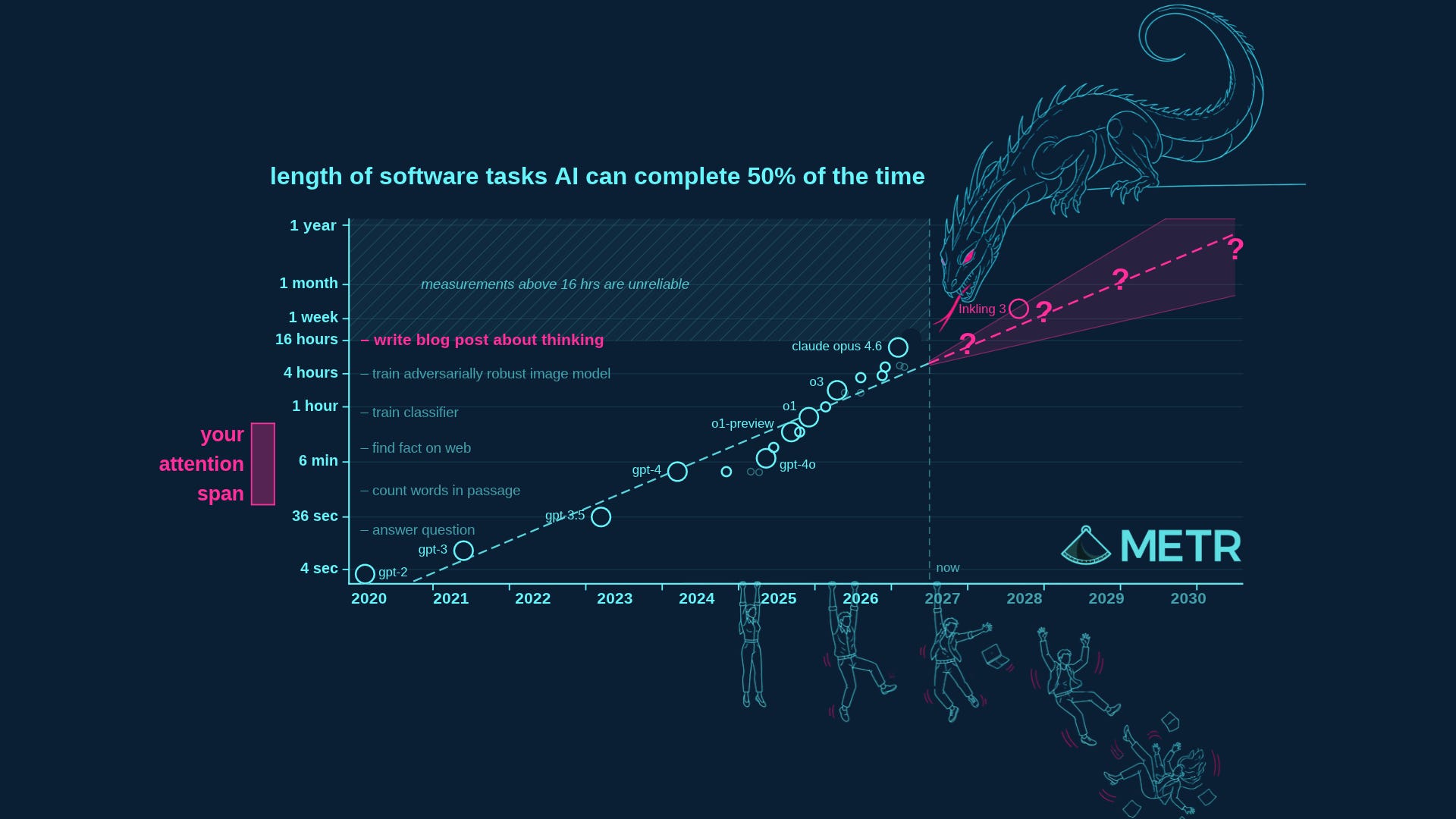
Disclaimer: Eliezer’s writing skill and the vibiness of doomers are not an argument against the proposition that we are getting paperclipped next year. That is a separate, difficult question, one that requires clear thinking and emotional wherewithal to address. I raised $40,000 for MIRI once and I don’t regret one cent; it’s the least I could do in gratitude to Yudkowsky for inspiring me to pursue better thinking. But in 2026, the pursuit of rationality requires looking beyond the rationalist community.
For non-rationalists, the main impact of AI on thinking comes from the y-axis on the chart. LLMs now work in longer chunks than your attention span. The human’s role has moved from senior lead, to collaborator, to manager, to patron who is left to appraise work he took no part in and can hardly understand. AIs will Peter-principle you if you let them.
Thinking alongside frontier LLMs requires inserting yourself into the loop by force, asking the AI to give you more options and frequent judgments, fixing those last few bits by hand until you get the actual outcome you wanted. Thinking requires something to protect — your intention and desire.
Jagged Sam
What of the machines? Are they good at thinking?
AIs today are better than most (if not all) humans at most tasks we associate with thinking and intelligence: math, coding, data synthesis, chess. They rarely stay at the human level for long: once an AI reaches human parity on a task, it can be used to write and judge reinforcement learning problems — the main way LLMs learn hard skills. Anything that can be graded in a classroom exam can be used to train models with RLVR.
Contra the Sequences, AIs do that despite being dogshit Bayesians out of the box. LLMs’ inner workings are probabilistic Bayes-approximators (as are human brains), but LLMs don’t naturally think in probabilistic terms and are poorly calibrated. You can impart superhuman Bayesianism to LLMs, but not by making them read Yudkowsky or Jaynes — you just chuck Bayes into RLVR along with everything else.
What LLMs are still bad at is integrating: learning new things on the fly, satisfying competing goals, translating symbolic knowledge to the real world, long-term coherence, metacognition. LLMs see the world through a microscope: superhuman focus, but no big picture. They don’t like messy realities, and they don’t have their own desires to protect. They love taking the first numeric measure provided to them and hill-climbing it.
To assess AIs in relation to human thinking we could consider an intermediate species: Sam Bankman-Fried.
Since everything these days is about AI, consider SBF as a misaligned AGI [...]
Having spent his entire childhood bored out of his mind, with no goal or utility function beyond not being bored, and having been sufficiently disabused of the virtues of academia, Sam did not know what to do. What would be a worthy goal or activity? Here we had this super smart person, lacking the motivations and interests that drive ordinary people, at a loss. What to do?
In stepped Will MacAskill, who suggested the goal of Number Go Up.
Zvi overlapped with Sam at Jane Street, where Sam was a successful trader. The corporate structure and management at JS do a great job at narrowing the scope of work required of traders, allowing them to focus on maximizing P&L. When Sam left to launch Alameda, things went well at first as he exploited a particular Bitcoin arbitrage to rake in huge profits.
But as time went on, Alameda came apart in exactly the ways AIs decohere. Half the management team quit in 2018, citing reckless risk-taking and sloppy accounting. Sam didn’t update his management style nor his trading strategy, doubling down on what worked previously even as the crypto market transformed around him. He failed to integrate his desire for fame and pussy, spending millions on flashy endorsements and installing his on-and-off girlfriend as Alameda CEO. He lost grip on reality just when the stakes were highest, tweeting cryptic threads, circulating delusional “balance sheets”, and giving a wildly incriminating interview as the investigation into FTX was ongoing.

At the same time, the goal he was ostensibly pursuing — helping humanity by proxy of making money by proxy of a number on a balance sheet — was prompted to him from outside, like an AI. For several years he didn’t stop to think whether what he was doing was truly furthering his purpose, because he had none that was truly his own.
Thinking, Narrow and Broad
I interviewed for a Jane Street internship in 2017, one month after Sam Bankman-Fried left the company. The interview process consisted of 11 hours of solving math puzzles: 3 on the phone, then 8 hours in a row in person. This was perhaps the most strenuous thinking effort I have ever exerted. The first 5 hours went fine. By 2 pm I started flagging but could force myself to concentrate on the geometries and permutations I was sketching on the whiteboard. At 4 pm my brain was fried; I apologized to my last interviewer and tried to make charming System 1 small talk in lieu of solving the puzzle. It was enough — I got in.
When people talk about thinking being “hard” they often mean that it’s effortful and requires stamina and glucose and scrunching your face. But it’s not that hard: there are very few activities I won’t get tired of 5-7 hours in, and even untrained people can spend 1-2 hours happily thinking over a sudoku, crossword, or video game. The hard part of thinking is getting started, especially, contra Eliezer, when the stakes are highest. When your crypto hedge fund is underwater, when a blog post is asking you to reorganize your life priorities, when you’re choosing a life partner.
The most productive hard thinking I’ve ever done was putting together a spreadsheet to decide which of two girls I wanted to date. TL;DR: I listed 15 qualities I want in a life partner, gave each one an importance weight, scored each girl on each quality. Eleven years later I am married to the one who scored higher. I didn’t think this was remarkable at the time; I wrote about the spreadsheet two years after the fact just to illustrate the technique of goal factoring. But it was! The spreadsheet story was featured on the cover of The Economist’s long-form magazine, and when my wife and I used the same approach to pick apartments we were featured in the New York Times. “Area man uses thinking to make life decision” is national news.
Apparently what you’re supposed to do when faced with an important decision is “follow your heart” or, in other words, vibe. Of course, the whole point of the spreadsheet was to clarify where my heart was leading me. I didn’t compare “humor” with “good parent” by pulling numbers from some actuarial table. I tried to visualize in deep detail an average mother who riffs on my bits so hard I can’t breathe for laughter, and contrast that with a moderately funny woman who enjoys engaging her kids all day in enriching activities. The hard thinking part was in holding on to all those possible futures without losing sight of the totality of what I want the rest of my married life to be.
To me, the core distinction between System 1 and System 2 thinking isn’t that one is fast and the other is good at math. System 1 is fast, effective, but often wrong because it aggressively filters out context, myopically following only the most salient detail. LLMs (and SBF) can do math at superhuman levels while ignoring everything else happening around them, or even remembering what the point of all that math even is. System 2 is what integrates information outside a single salience filter. It’s slow and sequential because integration has to make use of your working memory, which can only store a few chunks of information simultaneously.
The virtue of System 2 thinking when used well is allowing you to keep sight of your desires, intentions, and overall context as you’re solving narrow problems, whether you’re vibe-coding or wife-choosing. Over time, this integration becomes trained and partly automatized, a phenomenon called developing taste. But you have to start with thinking, and you have to not stop before you’re done.
Stop Signs
Every person has a powerful LLM available to them at all times: their left hemisphere. You prompt it with intentions (that themselves originate outside it) like “how to express this thought” or “what was that actor’s name?”, it cranks some kind of black-box process for some amount of time, then pings you with the output: an articulated sentence or “William Fichtner!”
Sometimes it seems to be malfunctioning: you prompted your inner LLM with noticing the mountain of chores you have to get done today, and instead of a working plan it output a strange mental fog and a compulsion to spend an hour on Twitter. But if you trace the output back through the chain of thought you will likely realize that your instruction wasn’t “get chores done” but “make me stop experiencing the anxiety that arose when I thought of the chore mountain”. Like any LLM, your left brain is a faithful but narrow-minded servant. It simply does what you asked it to, not what’s good for you.
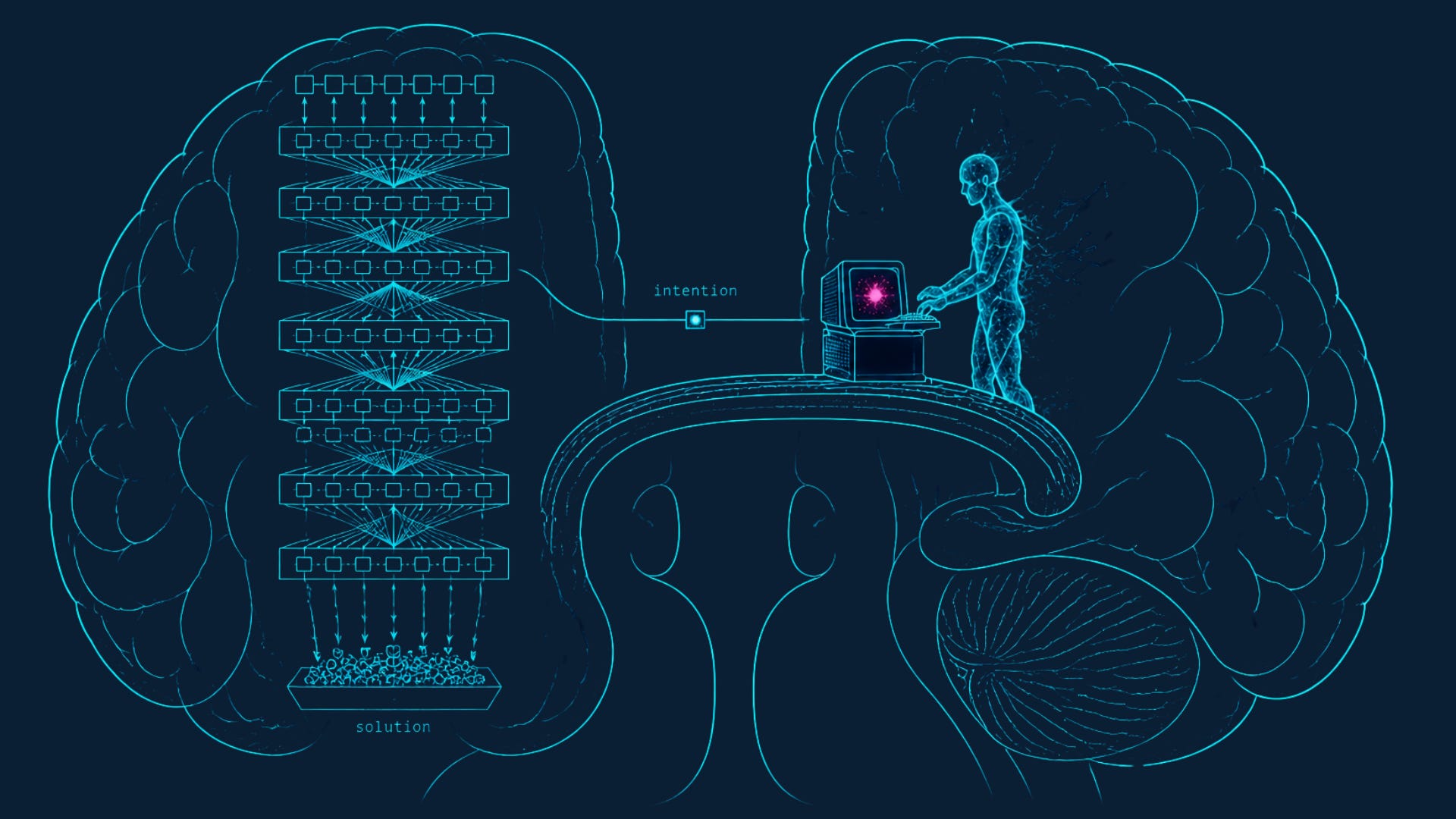
This model of mental machinery was articulated by Michael “Valentine” Smith, part of a series outlining his full worldview. It’s long, complex, and the most impactful thing I’ve read all year. I couldn’t recommend more strongly that you set an intention to read the whole thing, ideally more than once.
A key idea in Smith’s essay is “overlays”, the filtering your mind does in service of focusing on a task:
When I want a drink of water, I look up at my glass next to me. I see how to pick it up and drink from it.
What I typically don’t see is the endless detail about the glass: how it has fingerprints, or how it warps the images behind it in surprising ways, or how bands of light appear on its surface in ways that reflect but also shift the colors near it. Its shadow is complex. There are tiny bubbles clinging to the side.
The mind’s filtering process filtered out all that detail because it wasn’t relevant to the task. It’s “a glass”. Details of color don’t matter for picking it up and sipping water.
An overlay is broader than what I called the “System 1 salience filter” above. It includes persistent frameworks that you see the world through, like materialism, religiosity, or being a miserable bastard.
[...] the mind is quite terrible at knowing when it should stop adding a given overlay if there isn’t a clear “problem solved” condition.
Mental activity, like an LLM, runs until it is stopped. The halt signal can be an evaluation of the output as satisfactory (“ah yes, William Fichtner!” followed by a sense of relaxation) or a new prompt (a surge of anxiety followed by “oh my god why did I spend two hours on Twitter oh fuck I need to start doing some chore now!”). Absent a halt signal, the mind keeps chugging along the track whether it’s doing something recognizable as “thinking” or not.

This suggests that thinking aversion is a property of the halt signal, not of the process itself. When thinking leads to a new insight or answer, it often involves the integrating/broadening function of System 2 I mentioned above: snapping out of the default overlay your mind applied to the problem. It is that moment of snapping out that often triggers the halt signal.
An example is when the default overlay leads to the socially-acceptable or authority-approved answer, such that actually thinking about the problem might put you at risk of standing out. The arrival of COVID in the US was overdetermined weeks before it arrived and the stock market reacted. A moderate thinking effort would have sufficed to start buying masks and shorting stocks. But thinking about COVID in February made you look weird, so almost no one did.
For important life problems, the halt often comes from the looming shadow of an obligation to act, feel guilty, rewrite your self image, or retract your former views. If your broken relationship with your mom short-circuits to some cached answer like “she’s just an asshole” or “we’re just incompatible”, it may be because 5 minutes of actual thinking will force you to call her and apologize or, even worse, realize that you’ve become her. Ann Pierce posits that most interpersonal conflict can be avoided by applying the cognitive effort to understand the other person’s frame, but almost no one does it.
We Need a New Rationality
I don’t have a complete theory of thinking, how it works, what it’s for, how to improve it, what fucks with it. I just happened to notice that everyone is underthinking this problem, while acting like thinking itself is the problem.
To recap: academic psychology is barely interested in the question of thinking and is also a decades-long plane crash. Kahneman established a useful paradigm, but he was still stuck with the broken methods inherited from psychology. Eliezer and the applied rationalists made real progress and developed useful techniques, but Yud was always in it for the AI and many others have fallen for their own world-saving-shaped cult attractors. When strong new work on intelligence and thinking comes out, it is primarily in the service of understanding machine minds, not human minds. A few friends are chipping at the problem, but their work is slow and siloed.
Meantime, the enemies of thinking are legion. Every ideology and culture feeds you anti-thinking memes for its own self-preservation. The top self-help books on Amazon advertise ways to “stop negative thoughts”, “develop unthinking habits”, and “reject your thinking to end suffering”. Techies and former rationalists are flocking to a cult monastery that teaches that attachment to thinking is a threat to life on earth.
The challenge is great. A real science of thinking has to be multidisciplinary. At the very least, it has to include evolutionary biology and neuroscience, but also memetics, mimetics (a different thing!), psychoanalysis, and an understanding of emotions, intention, and desire that usually comes from schools of spirituality, not academia. I doubt a single person could hold all of it in their head, especially since the most promising ideas in each of these disciplines are often contradictory at first glance. Progress can only be made by people thinking together despite disagreements, willing to be wrong and to update.
Eliezer felt this when establishing rationality 1.0, and the Sequences conclude with a call to Go Forth and Create the Art!:
I hope that the part of the Art I have set down, as incomplete as it may be, can surpass that preliminary barrier—give people a base to build on; give them an idea that an Art exists, and somewhat of how it ought to be developed; and give them at least a saving throw before they instantaneously go astray.
That’s my dream—that this highly specialized-seeming art of answering confused questions, may be some of what is needed, in the very beginning, to go and complete the rest.
The art exists, and so does the barrier. Thinking is hard enough on its own. Thinking about thinking is that much harder to do without immediately dismissing, halting on a fake answer, or being distracted by this new exciting machine mind we invented. The machines think, but not quite like us. Understanding human thinking is all the more urgent if we want to figure out what is left for us to think about as machine thinking improves.
Maybe the hard part is just noticing where thinking doesn’t happen, and actually trying.

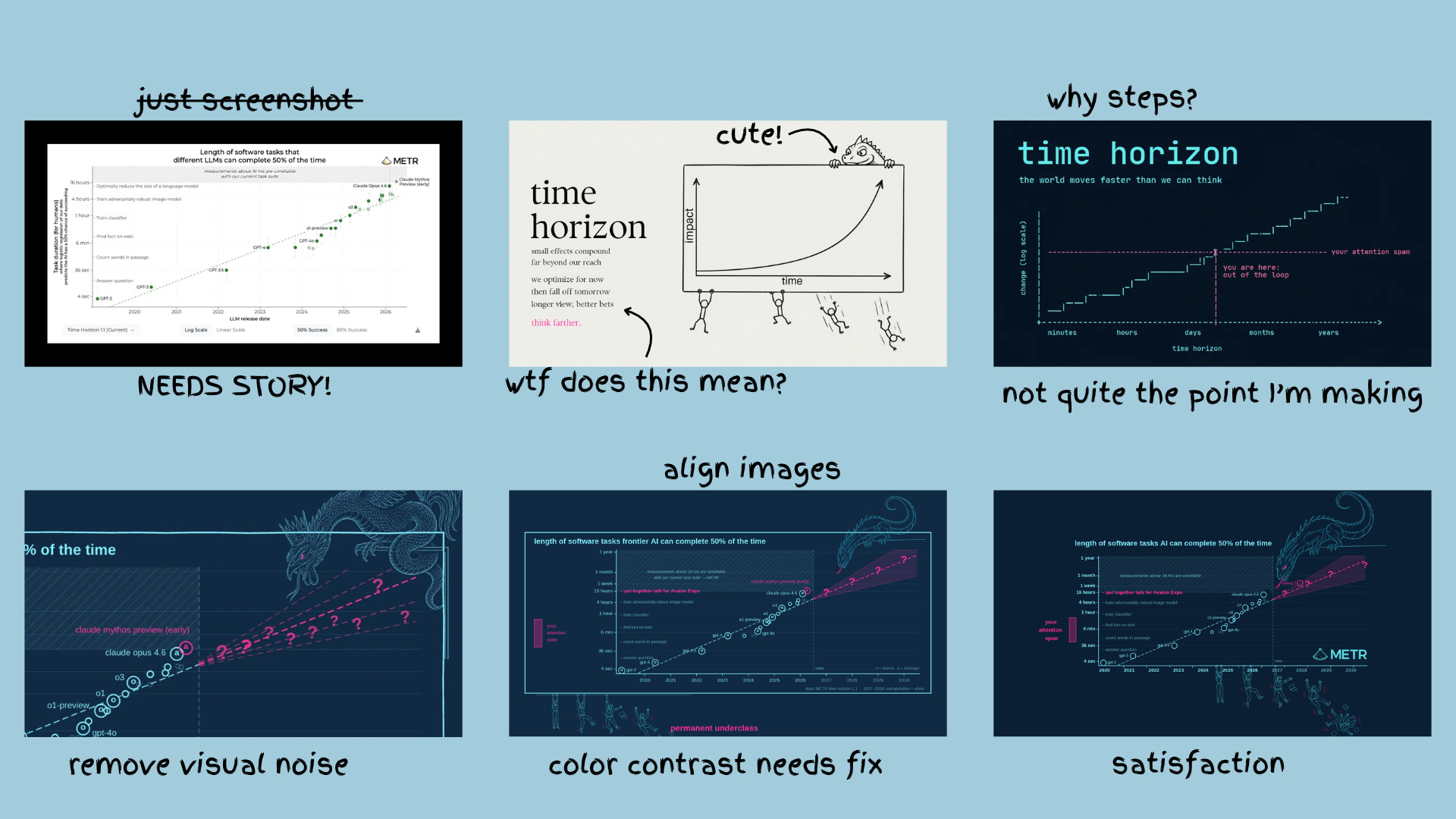
Thank you to Viv Belenky, Ivan Vendrov, and Chris Lakin for reviewing early drafts of this work. Thank you to Jonathan Wallis for inviting me to give a talk about thinking at the Avalon Exposition — that opportunity inspired this post, and the images in it are slides from that talk.
if you want to use left / right hemisphere, SBF seeemed to be pure left hemisphere. All thinking, no feeling (like a llm!) Seemed to almost repel what most would refer to as meaningful stuff. "Felt nothing in the presence of art. He found religion absurd.”