

Squeezed by the Bay Area housing market, Rationalists don’t let anyone live rent-free — even beliefs. They demand payment in anticipated experiences, and exile freeloaders to Marin County where no one can hear them falling in the woods.
But beliefs can also pay rent in other ways, such as existential comfort or coordination with others. People like these “theological” beliefs to be laid out scripture, which standardizes the belief for sharing with friends and gives it authoritative power. For the belief that God cares about you: the Bible. For the belief that Clippy doesn’t care: Superintelligence. For the belief that rich people deserve to have their shit stolen: Das Kapital. That the poor deserve to: crypto whitepapers.
Three out of five Americans believe a proposition for which there is neither scientific evidence nor a holy book1. A proposition that would seem to have important implications for their personal lives, yet it’s unclear what role it plays day-to-day. They believe in soulmates.

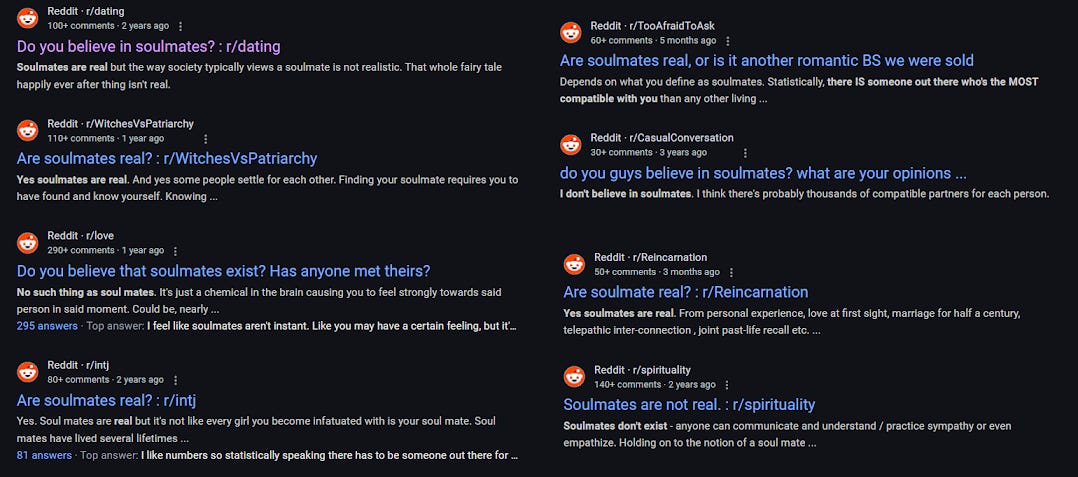
Are soulmates real? Let’s survey the experts. r/dating and r/Reincarnation argue for the affirmative, but r/love and r/spirituality stand firmly against. r/intj is judgy and nerdy, as you’d expect, and r/WitchesVsPatriarchy believes in you. Hmm, this question is proving trickier than anticipated. Let’s take a step back.
What exactly do people believe when they believe in soulmates? Here are some attributes commonly associated with the term:
Uniqueness — There is exactly one match for each person…
Predestination — …and fate will inevitably bring them together.
Immediate recognition — Soulmates will know each other at once…
Perfect compatibility — …and get along smoothly in an effortless fit.
Special connection — The spiritual bond makes you feel complete…
Permanence — …and once established, it lasts forever.
It’s pretty hard to reconcile all six attributes with the survey statistics. Partnered people are likeliest to believe in soulmates, yet few of them will say that getting along with their partner is smooth and effortless. The fact that divorced people are more soulmatey than singles is hard to reconcile with uniqueness, immediate recognition, or permanence. 70% of women believe in soulmates and love at first sight, but a similar number believe that you must never sleep with someone on the first date. Putting these together, at least half of these “romantic” women seem to believe that their true soulmate would be turned away by sex.
People’s behavior is also difficult to make sense of in light of this belief. People compile lists of mandatory attributes and icks, swipe endlessly on apps yet refuse to travel to the next town for a date, stay for years in crappy relationships yet “keep their options open” in promising ones. Whatever is going on, it seems more complicated than people explicitly endorsing the list of soulmate attributes and conducting their dating lives in accordance.
Can we make any sense of “soulmates”? Can we make any use of the idea? And where does this belief even come from if not from holy scripture nor from people’s personal experience?
I’m far from an authority on soulmates; my own wife predicted that married people would believe in soulmates less because “at that point they should know better”. But I know some things about sports movies, Mentos, wu wei, and game theory. It’s time to shed some light on soulmates.
Sally in Seattle
We know how people learn the idea of soulmates: not from a book, but from Meg Ryan.

Classic rom-coms are structured entirely around the idea. They invariably feature two people set on a collision course by destiny, obstacles and resistance overcome, a dramatic moment of recognition imbued with cosmic significance, and a happily-ever-after once the couple recognizes their soulmatehood. Were we all taught to expect our dating lives to unfold exactly like this?
Meg Ryan is 63 right now, and rom-coms were an early casualty of Hollywood’s death spiral into self-referential post-irony. No one makes sincere rom-coms anymore, and no one reading a Substack about dating remembers seeing a live one in person. There is something about the soulmate narrative that appeals separately to people and to 1990s Hollywood executives. That thing is: legibility.
Movies about love stories are weakly constrained by what people will find plausible and are strongly constrained by being a movie: they have only so many scenes.
A very common love story involves two acquaintances who didn’t date for several years as each went through their own series of almost-but-not-quite relationships. Eventually, they get together and build a partnership by overcoming a thousand small fights with ten thousand small gestures of love.
There’s no way to fit all of that into a two-hour run-time, in a way that someone half-watching on cable a decade later could understand at a glance what’s happening. Movies have to rely on a few recognizable story beats: the meet-cute, the revelation montage, the grand gesture. And there’s no way to fit the entirety of the development of a relationship into memory either. When people reflect on their lives they might remember just a few moments that stand out and combine into some coherent narrative.
This is especially true when you have to tell the story to someone else. If you ask a married person when they “knew it was the one” you’ll likely get some story about a particular moment even if the actual process of knowing took a decade. We’ve all been conditioned to expect this question and to have an answer ready. If you ask their spouse, you might even get the same answer.
Compare this to the beats of a sports movie: the scene establishing the protagonist as an underdog, the meeting with the wise mentor, the moment of almost quitting, the big game. The familiarity of these beats likewise is shaped by the constraints of the cinematic medium. No one really thinks that becoming a great athlete requires just these few scenes; everyone is aware of the years of regular practice that a movie might skip over in a two-minute montage. But when a gold medalist is interviewed years later, they will also remember the standout highs and lows and not linger over the grind which 99% of their career actually consisted of.
The rom-com narrative, like the sports movie narrative, applies mostly in retrospect and when recounting it to others. It’s why married couples, with a long and complicated history to their current relationship, endorse soulmates more than singles. But people don’t live their lives prospectively like a Meg Ryan character, waiting for a cosmic sign to drop everything in pursuit of a destined stranger.
Non-Doing
The rom-com narrative is also appealing to single people, of course. It’s nice to fantasize about your hands brushing someone’s as you both reach for the last sleeve of Mentos at the store, your eyes locking in a moment of recognition, the tension turning to bliss as you impress each other with movie script-worthy banter.
Question: Which one of you has the first line in the script? Do you regularly practice making engaging conversation about Mentos in preparation for the fateful moment? If making small talk with strangers often feels difficult and stressful, do you imagine that it would be magically easier when that stranger is so beautiful you’re liable to fall in love with them?
The fantasy of sports stardom often gets aspiring athletes up early to go to the gym. The rom-com fantasy, however, seems to demotivate effort. A soulmate is predestined: it doesn’t require you to act. And a soulmate loves you for who you are: it doesn’t require you to change. So what purpose does the soulmate fantasy serve?
There are two plausible answers.
The cynical answer: “Soulmate” isn’t a belief, it’s a defense mechanism. It’s an excuse to be absolved from agency. Believing in soulmates means that you don’t bear responsibility for your own loneliness, nor have to face the anxiety of volition and the uncertainty of self-transformation. You desire not love but unaccountability.
The anti-cynical answer: “soulmate” rejects the transactional view of relationships, one in which we coldly measure each other’s “market value” and look for a good deal instead of for connection. That view doesn’t even serve itself: those who hold it succumb to antisocial resentment or crippling self-doubt. The romantic doesn’t reject agency, rather she embraces authenticity — doing what feels right and not what is calculated.
I think that both answers are true, even for the same person. Dating requires a delicate balance of doing and non-doing. You don’t want your soulmate to be inert and scared of change, though sometimes you are just so yourself. And you don’t want them to be a calculating optimizer, though sometimes you are tempted to calculate and optimize. Fantasizing about soulmates is perhaps how people seek this delicate balance.
Stopping Rule
Though it’s hard to find reliable surveys, it seems that belief in soulmates has gone slightly up in the last 20 years. At the very least, there is no sign that the proliferation of online dating destroyed the house that Meg Ryan built. This may seem paradoxical: if your dating options are limited but each is highly compatible, it makes sense to think that the best of them is your soulmate. How does belief in soulmates persist among people exposed to a seemingly endless supply of interchangeable Tinder faces?

Belief in soulmates can be thought of as an adaptive reaction to the overwhelm of choice in the digital age. It offers a relief from the anxiety of constant comparison and FOMO, a way to step off the carousel.
Belief in soulmates suggests a binary strategy for investing in a relationship. IF soulmate THEN invest a lot and persevere through trouble ELSE break up quickly and move on. This is a strong strategy in a world of option overload regardless of the actual criterion for determining a soulmate, as long as both you and your partner have the same criterion for switching modes. “Soulmate” is a framework enabling two people to delete the apps and give happily-ever-after a shot at the same time.
I think a common soulmate criterion people look for is, indeed, a “magic movie moment”. A memorable shared experience that feels unique and transformative. The sort of scene where, if you were Meg Ryan, the uplifting music would kick in as the camera zooms on your faces. Your eyes lock in an unspoken agreement: “you are no longer disposable; I’m activating soulmate-mode.”
Of course, having such an experience isn’t the most reliable indicator of long-term compatibility. You might have a list of thoughtful criteria that you look for in a partner over time, things such as the expected quality of their parenting or their potential for continuous self-improvement. While these may form a much better basis for a relationship, they don’t solve the problem of simultaneous commitment. If people are worried about committing unilaterally, or prefer to trust their gut over reasoned lists, they will lean towards the soulmate approach.
Dating is a coordination game, and advertising your belief in soulmates is a signal of your willingness to cooperate. If you meet another soulmate believer and share a unique and special experience, you both jump to the good equilibrium of mutual investment and fidelity. Since the majority of other daters also believe in soulmates, it’s a deceptively wise strategy for navigating modern dating.
Who’s the Soulmate?
Like Christianity, socialism, and DeFi, “soulmates” are a flexible concept that means different things to different people. It’s an attitude you can adopt towards someone else or towards your own dating life, not a concrete statement of fact. Rather than asking whether the belief in soulmates is true, it’s more enlightening to ask whether it’s adaptive.
It can be, when belief in soulmates is an escape from the deranging effects of the dating “market”, a signal of your desire to dedicate yourself to one other person and a beacon for that person to find you. It preserves your authenticity, creates space for feeling grand emotions, and saves your energy for the rare relationship that actually matters.
On the maladaptive side, belief in soulmates can be dumb cope. An abdication of agency and of responsibility for yourself and others. A fatalistic helplessness that is only slightly more tolerable than facing the fact that being alone or in a shit relationship is nothing but a skill issue, that if you simply were better you’d do better too.
What separates the two is a fine point that’s rarely addressed in discussions of “soulmates”: Who’s the actual soulmate you believe in, the second person or yourself?
The soulmate belief is adaptive when you apply it to others. When you believe your soulmate is out there, you look for them, you anticipate sharing a magical experience and then devoting yourself to them unconditionally. But when the belief in soulmates is turned inward it turns toxic: you think of the joy you’re entitled to for being the soulmateable person you believe yourself to be, expecting someone to love you for “who you are” while doing little to facilitate or reciprocate their devotion.
This trap applies to so many other concepts and ideas in dating: market value, masculinity and femininity, authenticity, various taxonomies and typologies. If you use them to look outward in search of your partner, they help you reach your goal. If you make them part of your identity, you lock yourself away in narcissism.
This will be the subject of our next chapter. Brace yourself for some uncomfortable introspection and a whole lot of TLP quotes.
Don’t pretend you read Plato’s Symposium for dating advice (or at all).
"Life can only be understood backwards; but it must be lived forwards."
The idea of a soulmate is a simple consequence of the way we tell stories: told in hindsight, with fundamentally deterministic characters and endings. Which is inherently at odds with the way we experience real life.
This is why I love improv so much - as the only form of storytelling which doesn't presuppose an ending, where actors are free to redefine themselves and the context of the story as they please.
For more on this theme, there is a beautiful video by Like Stories of Old on the difference between stories and reality: https://www.youtube.com/watch?v=1sWdBo-k2iA&list=PLNwwHxpB-dkwXVUYJUEZusEKIFAmqvSd8&index=3
This post assumes that soulmates only exist in romantic settings, which I don’t quite agree with. Most of the reasoning seems to be based on that assumption. A soulmate can just as easily be a close friend. In both contexts, what matters most is companionship. People in long-term relationships often experience this and come to believe in soulmates.
Ultimately, love or a soulmate isn’t about ticking boxes; it might simply be the willingness to stay.
Btw, I found your last point about believing in soulmates helping one accept others or requiring unconditional acceptance thought-provoking and truly insightful.