

Instructions Unclear
Isn’t it strange that most dating books are shelved in the self-help section? People don’t read science books for lab setup instructions or history books only when they’re personally attempting to conquer Carthage. But they expect dating essays to be written like an online recipe: a self-deprecating story you scroll past, an assurance that things will turn out well, and, finally, a list of specific instructions.
Here’s the description of the first sponsored result for “dating book” on Amazon:

My secret formula to attract 83% more charming gentlemen and dreamy girls to Second Person is to write the exact opposite of whatever that is.
Instead, this is going to be a blog about self-knowledge: seeing your dating self and your path ahead with clarity. Self-discovery is a long journey. Let’s start with this question:
Were you hoping for actual instructions instead of this self-discovery nonsense? If so, what were you going to do with these instructions?
This is multiple choice with no time limit, so take a minute to think.
You were going to nod along with the advice you already agreed with and roll your eyes at stuff you would never try anyway.
You would pick one or two new tricks from the list to experiment with.
A true believer, you were committed to following my directions in full.
You actually weren’t hoping for instructions and are relieved to have your own option on this list.
#1 is self-help as entertainment. Fair enough, I’m here to entertain! I published 109 pieces of life advice once. Readers loved it, it even got syndicated in a foreign newspaper. But it only ever received comments of two sorts: “#34 is great, I do it all the time” or “#81 is crazy, why would you think it’s a good idea?” No one wrote back a month later to say they tried something they were initially skeptical about and it worked out.
#2 is also common, though it’s unlikely to be of much use. Any worthwhile collection of advice is a distillation of some richer philosophy that the writer actually holds. It’s that philosophy which got them the outcomes you want. You want to extrapolate the broad worldview from the advice, not to pick standalone bits of it out of context.
#3 invites the question: why me? I haven’t done anything so far to earn your unquestioning obedience. I haven’t even posted the obligatory photo of me at a swanky party surrounded by hot girls (who try to look like they weren’t paid to be there).
Is your goal to improve your dating life or simply to not be responsible for it anymore? I’m the one writing a dating blog and you paid $50 to be here. You’re no longer to blame for anything. It’s on me now. Whew.
This sounds a bit crazy, but you can see it everywhere. People talk nostalgically about ye olden times when weddings would be arranged by their families. They sign up for boot camps with gurus promising dates with 9s and 10s for just 12 monthly installments. They enlist matchmakers and eagerly await “AI dating concierges” that would pair them with an algorithmically optimal partner. People want someone, anyone, to run their romantic lives so they wouldn’t have to.

General Advisory
The problem is: it’s your dating life. To invert a common bit of advice: you’re fighting a battle everyone else knows little about. You’re not trying to cook the same quiche as the author using the same ingredients. You’re a special egg, you need your own secret sauce.
Book advice is about raising the generic dateability of a general person. So much of it is already “in the water supply”: pick good photos, join a gym, plan thoughtful dates, be nice to the waiter, don’t mention your ex… You’ve heard it before. Everyone else has heard it. And yet everyone is still struggling, and still buying dating self-help books.
One reason everyone is struggling is that they’re not doing the obvious things everyone knows you should. Reading about it in one more book won’t change that.
But the main reason is that a lack of generic dateability isn’t any single person’s real problem. Whoever you are, there’s someone out there who is hotter, funnier, nicer to the waiter, and dodges conversation about their ex more smoothly. There’s also someone who’s worse at all of those and is happily married.
And there’s someone out there who’s your dream partner, the person you could create a great relationship with. They’re not the most universally dateable person you’ll meet, the one who follows all the dating advice to a T. And they’re not looking for that either.
Generic dating advice is a distraction. It puts you in the mindset of competing with everyone for the approval of everyone. You forget to look for the person whose approval matters.
Mate: Become the Man Diana Wants
Mate: Become the Man Women Want by Tucker Max and Geoffrey Miller is the best of all the dating advice books I’ve read. It’s the best book for men because it offers the right principle: adopting the point of view of the girl you’re trying to date and becoming the mate she wants. It encourages men to fundamentally change their value proposition to women, instead of looking for tricks to improve their dating outcomes while remaining the same desperate-for-dating-advice losers they were to start with.
It doesn’t have advice for women, but most dating books for women are counterproductive. We’ll explore this unfortunate situation in depth next week.
Mate lists several traits that women have evolved to look for in men and instructs men in cultivating and displaying these traits.
On intelligence:
Book smarts (or academic intelligence) are important for economic success — but they’re not that important for mating success because books didn’t exist in prehistory.
- page 118
On reacting to women flirting:
If you want to turn her self-consciousness up to 11, be the guy who can’t seem to pick up on her signs of interest in you either. That one is a killer for any young woman who has put herself out there.
- page 40
On happiness:
If you’re trying to create new relationships with women, […] sadness is not an attractive strategy. Women don’t adopt boyfriends out of pity (they do that with puppies); they want a guy whose happiness cup overflows into theirs.
- page 99
On social capital:
Social outcasts just couldn’t bring home the bacon. The same holds true today: it’s very hard to make a good living as an introverted hermit, since economic success still depends heavily on social networks and getting along well with coworkers, bosses, mentors, investors, customers, clients, and fans.
- page 176
On shared interests:
Think about putting yourself into social groups and activities that include women, where you do things you already enjoy with people you like.
- page 265
This is all great advice.
A few years after Mate was published, I met Geoffrey and his wife, Diana Fleischman. Curious how Geoffrey’s great dating advice worked in practice, I asked Diana how they got together.
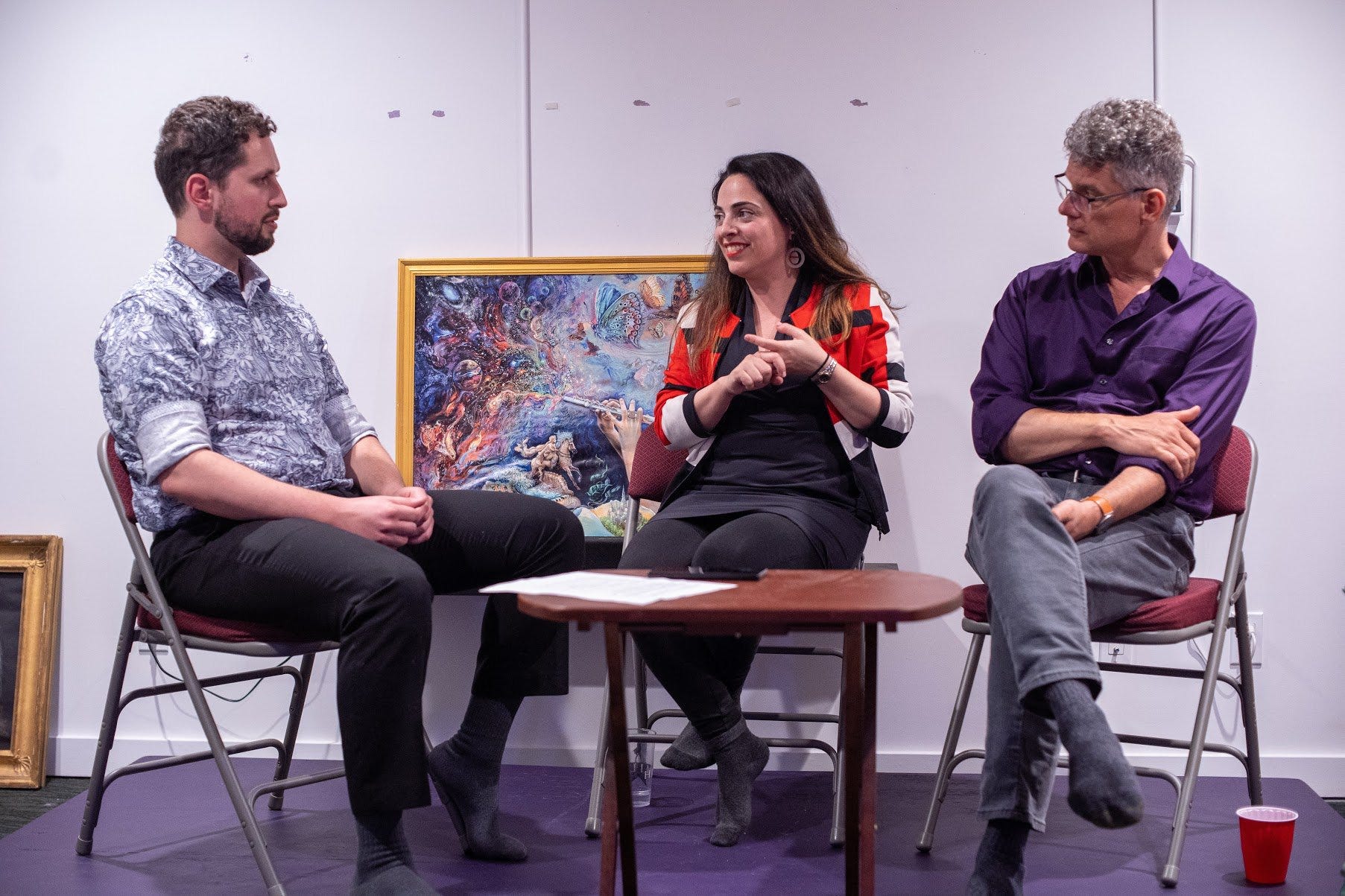
Diana first encountered Geoffrey through complex academic book The Mating Mind in 2002. She was 21 at the time; Geoffrey was 36 and married. The book left such an impression that she resolved to meet him in person. It took a decade for that meeting to finally occur:
I tried to chat Geoffrey up in 2012, soon after his divorce. And my trick at the time for chatting up people who are introverted and quiet was to disclose more and more embarrassing things about myself until I got a reaction. So I was trying to draw him out, and he was like a clam in his shell. He wasn’t giving me signals of interest. He wasn’t even properly facing me.
So I said, “Well, you must have plenty of other people to talk to, I’ll let you be.” And he answered, “No, no. This is fine.”
Diana and Geoffrey shared a passion for evolutionary psychology. Aside from that, Diana was a polyamorous vegan living in England. Geoffrey was a paleo CrossFit trad bro who lived in Austin. Diana bridged the gap by telling Geoffrey that her boyfriend was very supportive because he liked Geoffrey’s books. She insisted that they all hang out naked in a hot tub together. This was Geoffrey’s first introduction to polyamory.
Then, in 2013, Geoffrey tweeted: “Dear obese Ph.D. applicants: if you didn’t have the willpower to stop eating carbs, you won’t have the willpower to do a dissertation #truth” This launched one of the early famous online outrage mobs as hundreds of people inundated Geoffrey’s academic employers with demands to fire him. Geoffrey was eventually censured by his university, and the episode sunk him into a mild depression.
Diana decided that being a famous cancellee is kinda hot and that a tendency to depression is a good counterweight to her own slight inclination to mania. As a consequence of ignoring every piece of specific advice in the book, Geoffrey and Diana are now happily married with two young children.
The problem with the advice in Mate isn’t that it’s bad. The problem is that everyone agrees that it’s good. If you follow this advice, everyone will dutifully agree that you’re very dateable. But “everyone” won’t date you.
Ultimately, you can’t just do what appeals to everyone. You have to appeal to one person (and in some rare cases, also her boyfriend). Geoffrey didn’t need to become the “man women want”, as his book promises to make you. He had to become the one Diana wants.
He did follow the main principle of Mate: he demonstrated to Diana the attractive traits he spent his life cultivating. He showed intellectual rigor, strong values, openness to exploration, and persistence. In doing so, he made a lot of women mad, but he got the woman he wanted.